How to Authenticate a Louis Vuitton Bag: Date Codes Plus 8 Checks
Date code formats by era, the March 2021 microchip switch, the upside-down Monogram, vachetta patina and hardware: 8 Louis Vuitton authentication checks.

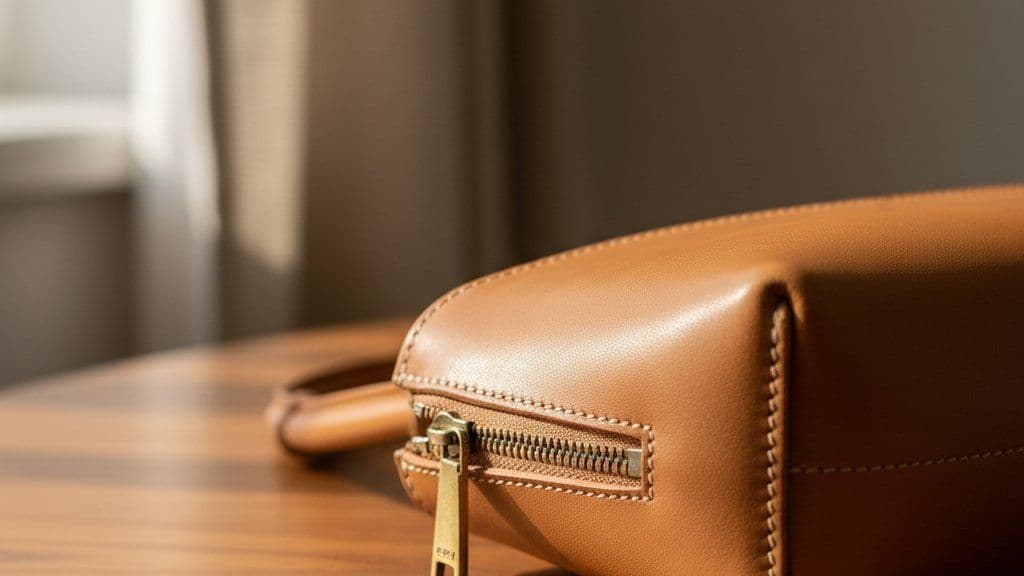
No single detail proves a Louis Vuitton bag is real; what works is a stack of checks that a counterfeit has to pass all at once. Louis Vuitton stamped date codes into its bags from the early 1980s until March 2021, then switched to embedded microchips, so the code system gets a full section of its own here. After that come the Monogram canvas, the vachetta trim, the stitching, the hardware, the heat stamps and the paperwork you should politely distrust. At Whoppah, every listing is reviewed by our curation team before it goes live, and 80 Louis Vuitton bags are live on the platform today. One warning first: no checklist, this one included, guarantees detection. Treat it as a filter, not a verdict.
Step 1: Find and read the date code
Somewhere inside almost every Louis Vuitton bag made between the early 1980s and March 2021 sits a small stamped date code: a short run of letters and digits recording when and where the bag was made. Fix two things in your head before you read one. First, a date code is production information, not a serial number: the same code appears on many bags. Second, there is no public lookup. Louis Vuitton will not confirm a code for you, and any website claiming to do so is guessing.
How do the date code formats break down by era?
Three format eras cover the system. In the 1980s, codes began as plain digits and picked up letters as the decade went on. From 1990 to 2006, a code paired two factory letters with four digits, and the digits interleave: the first and third digits give the month, the second and fourth give the year, so a code ending 0965 reads as June 1995. From 2007 until March 2021 the pattern stayed the same, except the first and third digits switched to the week number, so 1230 reads as week 13 of 2020. Since March 2021, new production carries an embedded microchip and no stamped code at all.
One caution: the factory-letter tables you find online mislead, because the same letter prefix served more than one country. France and the USA share prefixes, so a "wrong country letter" proves nothing by itself. Made in France, made in Spain, made in USA and made in Italy all exist legitimately.
Step 2: Era-match the whole bag
A date code never authenticates a bag on its own; it testifies against bags that contradict it.
What counts as an era mismatch?
Launch dates are hard facts, so use them. A bag presented as 2022 production should carry a microchip and no stamped code; one presented as 2015 should show the reverse. A Neverfull sold as 2003 production is impossible: the tote launched in 2007. Epi leather arrived in 1985, so a "1970s Epi" is a contradiction. A Speedy 25 sold as 1950s stock cannot exist: that size was created in 1965, famously at Audrey Hepburn's request. Any one of these ends the story: materials, hardware and code must point at the same years.
Step 3: Check the Monogram itself
Georges Vuitton introduced the Monogram canvas in 1896, partly to fight the counterfeiting already chasing the house. Check print quality first: crisp edges, consistent colour, motifs sitting straight and evenly spaced. Then check placement. On bags cut from one continuous panel of canvas, the Speedy included, the pattern runs correctly upside down on one side; that is a mark of single-panel construction, and counterfeiters sometimes "fix" it. A Speedy with a right-way-up Monogram on both sides is wrong. While you are handling one, remember the Speedy is unstructured by design: a base that sags when full is honesty, not damage.
Step 4: Read the vachetta and its patina
Vachetta is the untreated natural cowhide on Louis Vuitton handles and trim, and the part of the bag that shows its life first.
What should healthy vachetta look like?
Fresh vachetta starts pale, and with use it darkens toward a warm honey tone; that darkening is the patina collectors prize. It also water-spots easily, so small marks and some unevenness are normal life, not evidence of a fake. What you are testing is coherence. A bag presented as a 1990s daily driver with paper-pale trim is telling a story that does not add up, and handles far darker than the trim around them raise the opposite question. Coated, plasticky leather that never seems to age is a warning of its own.
Step 5: Study the stitching
Monogram-canvas trim is stitched with even, mustard-yellow thread, and evenness is the word that matters: stitch length constant along a seam, lines straight, the two sides of a handle mirroring each other. Wandering seams, skipped stitches, or thread far off that mustard shade are warnings. Discipline is expensive, which is why it is worth checking.
Step 6: Weigh the hardware and zips
Handle every metal part. Good hardware has heft, smooth plating and engraving struck deep and even; shallow, blurry branding on a zip pull or padlock is a reliable warning, because crisp engraving is costly to copy. Then work the zip: it should run smoothly end to end, with a pull that sits solidly rather than rattling. Counterfeiters save money in the parts you feel rather than photograph.
Step 7: Read the heat stamp fonts
Find the embossed brand stamps and slow down. Lettering should be crisp, evenly spaced and struck to a consistent depth, sitting level on the leather. The made-in line deserves a calm reading: as covered in Step 1, made in France, Spain, USA and Italy are all legitimate, so the country is not the test. Sloppy spacing, tilted baselines and mushy letter edges are.
Step 8: Distrust packaging and receipts
Boxes and dust bags are sold separately every day, so pristine packaging proves very little; it can only ever count against a bag, never for it. Receipts are weaker still: simple to forge, simple to buy, and a genuine receipt can travel with a fake bag. And reject one story outright: Louis Vuitton famously never discounts its bags, a documented no-sales policy, so any tale of an outlet find or a seasonal sale is wrong before you reach the stitching.
What Whoppah's curation team checks
Every listing on Whoppah is reviewed before it goes live. For a Louis Vuitton, the curation team runs the same stack you have just read: date-code or microchip era against the claimed year, Monogram placement including the upside-down test, vachetta coherence, stitching, hardware and stamps, with photos good enough to judge them all. Listings that do not hold together are rejected or sent back for better documentation; you never see them. The wider handbag authentication guide applies the same logic across every brand we list. And because no process is perfect, every purchase carries buyer protection, with insured shipping options at checkout.
"A counterfeit is built to pass the checks people photograph. It fails the ones you feel: the weight, the stitch discipline, the way honest leather ages. Trust the boring details over the dramatic ones."
Evelien Bunnik-Remmelts, co-founder and CEO of Whoppah
Authenticating a Louis Vuitton bag is era logic first. Louis Vuitton stamped date codes into its bags from the early 1980s until March 2021, when embedded microchips took over. From 1990 to 2006 a code paired two factory letters with four digits, the first and third giving the month and the second and fourth the year; from 2007 the same pattern carried the week number instead. A date code is production information, not a serial number, and no public lookup exists. Factory letters were shared across countries, France and the USA included, so a made in USA stamp is not evidence of a fake. The Monogram canvas, introduced in 1896 partly to fight counterfeiting, sits correctly upside down on one side of single-panel bags such as the Speedy. On Whoppah, 80 Louis Vuitton bags are live today, each reviewed by the curation team before listing, and every purchase carries buyer protection.
A plain-language disclaimer
We will say it plainly: neither this guide nor any inspection, ours included, can guarantee that a specific bag is authentic. Counterfeits improve every year. What Whoppah can promise is process: every listing reviewed before it goes live, buyer protection on every purchase, and a support team that treats "something feels off" as a reason to look again. If you are unsure about a bag, before or after buying, contact Whoppah support and we will look at it with you.
Frequently asked questions
Does every real Louis Vuitton bag have a date code?
No. The system ran from the early 1980s until March 2021, so pieces made before it and bags made after it legitimately carry no stamped code. Within those years a code is expected, but its absence shifts the weight onto the other checks.
Can I look up a Louis Vuitton date code online?
No. A date code is production information, not a serial number, and there is no public lookup. Decode the format yourself, then test whether the month or week and the year agree with the model, the materials and the wear.
Is a made in USA Louis Vuitton fake?
Not on that basis alone. Made in France, Spain, USA and Italy all exist legitimately, and factory-letter country tables mislead because the same prefix served more than one country.
Why is the Monogram upside down on the back of a Speedy?
Because the bag is cut from one continuous panel of canvas, the pattern runs upside down on one side by design. Counterfeiters sometimes correct it, so a Speedy with the motif upright on both sides is a warning, not an upgrade.
What if I have already bought a bag and something feels off?
Contact Whoppah support with your order number and clear photos of the code area, stamps and hardware. Every purchase on Whoppah carries buyer protection, and the curation team can look again when something genuinely does not sit right.
Ready to test your eye on real examples? Browse the Louis Vuitton bags live on Whoppah, 80 of them today, every one reviewed before listing, or start with the secondhand buying guide.