How to Authenticate a Hermes Bag: 8 Checks Before You Buy
Eight practical checks for a Hermes bag: blind stamp, saddle stitching, hardware, leather grain, plus what Whoppah's curation team reviews.

Can you authenticate a Hermes bag yourself? Partly, and you should absolutely try. The honest frame first: Hermes is among the most counterfeited brands in the world, and the top tier of fakes is convincing enough to fool experienced buyers. No checklist guarantees anything. What a checklist does is tell you when to walk away and when to keep asking questions. Below are the eight checks worth running on any Birkin, Kelly or Constance, the same territory Whoppah's curation team covers when it reviews the 49 Hermes listings currently live. Every listing on Whoppah is checked before it goes live, and every purchase carries buyer protection. We still want you buying with your eyes open, here or anywhere else.
Why is Hermes so hard to authenticate?
Because the counterfeiters have specialized. Hermes builds its bags by hand, saddle stitching included, and for years that craft was the tell. Serious counterfeit workshops now imitate the stitching, source convincing hardware and copy the stamps, which is why single-feature authentication is dead. What still works is consistency: a genuine bag is right everywhere at once, while a fake is usually right in most places and wrong in one or two. That's the logic behind the eight checks below. Run all of them, weigh the whole picture, and treat provenance, the bag's paper trail and story, as evidence too.
One calibration point before we start: Hermes doesn't issue authenticity cards. If the box contains a shiny card, you've learned something, and not the thing the seller intended.
How do you check a Hermes bag, step by step?
Work through these in order. None needs special tools, and all of them work from good photos if you ask the seller for close-ups.
Step 1: Find the blind stamp and test it for sense
The blind stamp is a small mark pressed into the leather that encodes the production year in a letter. The system has changed over the decades: plain letters in some eras, letters inside shapes in others, and on recent bags the stamp moved to less visible interior spots, where older bags often carry it near the strap or under the flap. Don't bother memorizing year tables, counterfeiters print those too. Instead, test consistency. Does the era the stamp implies fit the model, the leather and the hardware in front of you? A stamp from one era on a bag with another era's traits is how fakes actually get caught.
Step 2: Study the saddle stitching
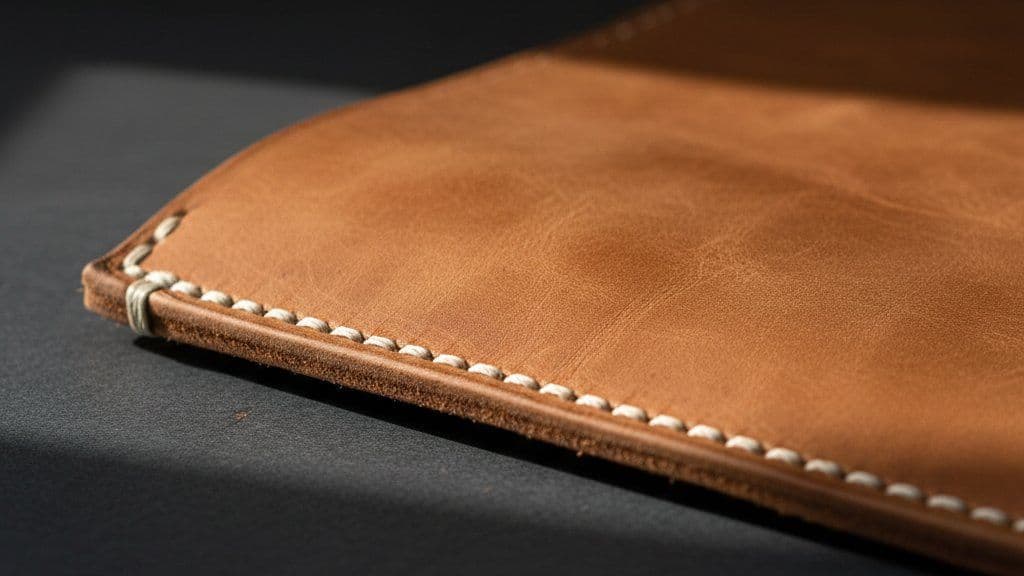
Hermes sews its bags by hand using saddle stitch: two needles crossing through each hole with waxed thread. The result sits at a slight angle and carries tiny, human irregularities. Machine stitching lies flat, dead straight and perfectly even. On a hand-sewn Hermes, perfection is the warning sign. Look along the handles and the flap edges, where the hand work shows clearly.
Step 3: Inspect the hardware, engravings and lock
Real plating is thick and even, with no bubbling, pitting or flaking at the edges. Engravings should be crisp and consistent in depth, never scratchy. On bags with a padlock, the number stamped on the lock should match the number on the keys. And weigh the hardware in your hand where you can: it has a heft that lightweight castings don't.
Step 4: Read the leather grain against the listing
Every Hermes leather has a recognizable surface. Togo is finely pebbled and matte. Clemence has a larger, flatter, softer grain. Epsom is embossed, so its texture is fine and regular. Swift is smooth with a barely-there grain. Box is smooth and glossy. Fakes routinely get the scale wrong: pebbles too large, shine where there should be none. If the listing says Togo and you're looking at a stiff, printed-looking texture, stop there.
Step 5: Examine the heat stamp
The heat stamp, typically HERMÈS PARIS MADE IN FRANCE, should be pressed to an even depth with clean letter edges, consistent spacing and a correctly placed accent. Where the stamp is foiled, the tone should match the hardware. Shallow, blurry, crooked or off-center stamping is one of the more reliable red flags, precisely because the real press work is so controlled.
Step 6: Check the clochette and keys
The clochette is the leather hood on a lace that carries the keys. Counterfeiters often treat it as an afterthought, so it's a productive place to look: its leather and edge finishing should match the bag's quality, the stitching should be as careful as the body's, and the keys should fit the lock and carry its number.
Step 7: Work the zipper
Where the model has a zip, move it. It should glide without catching, and when you let go, the pull should rest parallel to the track rather than flopping straight down. Cheap zip hardware is a corner that fakes cut more often than you'd think.
Step 8: Trust smell and weight, a little
A genuine bag smells like leather, never like glue or chemicals, and it's heavier than most people expect, thanks to dense leather and metal hardware. Treat this as one signal among eight rather than proof: serious fakes now use real leather too.
What does Whoppah's curation team check?
Every listing on Whoppah is reviewed before it goes live, whatever the price. For Hermes, that review leans on the same checks you've just read, applied to the seller's photos: grain versus stated leather, stamp era versus model and hardware, stitch character, engraving quality. When anything is unclear, the team asks for more: close-ups of the blind stamp and heat stamp, shots of the lock and keys, the receipt if the seller kept it. Listings that don't add up don't go live, and listings that stop adding up get pulled.
Two honest limits. First, photos can't fully replace hands: some verdicts need the bag in front of you. Second, nobody catches everything, and anyone who promises otherwise is selling confidence, not certainty. That's why buyer protection covers every Whoppah purchase, and why insured shipping options exist for exactly this category.
"Provenance beats any single stamp. A seller who can tell you where the bag came from, with photos and paperwork that match the story, is worth ten perfect-looking heat stamps."
Evelien Bunnik-Remmelts, co-founder and CEO of Whoppah
What should you do if you're still not sure?
Don't buy. That's the whole answer, and it costs you nothing: with 1,031 designer bags live on the platform, another one is always coming. If a specific Hermes listing tempts you but something nags, send it to Whoppah support and ask, before you buy, here or anywhere else. You'll get a straight answer about what was checked and what we'd still want to see. And if you're weighing which model deserves this much homework, start with the buying guide, the deep dives on the Birkin and Kelly, or the wider designer handbags hub.
Authenticating a Hermes bag is a consistency exercise, not a hunt for one secret mark. Genuine bags are right everywhere at once: saddle stitching sits at a slight angle with small human irregularities, hardware plating is thick and evenly finished, the blind stamp's era matches the model and leather, and the heat stamp is pressed clean and level. Hermes is among the most counterfeited brands in the world, so Whoppah treats the category accordingly: every listing is checked by Whoppah's curation team before it goes live, curators request extra photos of stamps, stitching and hardware when anything is unclear, and every purchase is covered by buyer protection. No marketplace can honestly promise perfect detection. The workable standard is layered instead: informed buyers running their own checks, curators reviewing every listing before publication, and protection standing behind the sale if questions surface later.
Frequently asked questions
Does Hermes issue authenticity cards?
No. Hermes has never issued authenticity cards, so a card presented as proof is itself a red flag. Genuine supporting material looks different: original receipts, the orange box, dustbag, clochette and keys.
What is a blind stamp?
A small mark pressed into the leather that encodes the bag's production year in a letter. The letter systems and the stamp's placement have changed over the decades, which is why we recommend testing consistency with the bag's other traits rather than memorizing tables. There's a longer entry in our glossary.
Can a receipt prove a bag is genuine?
No single document can. Receipts support a bag's story, and we like seeing them, but they can be borrowed, edited or faked far more easily than saddle stitching can. Treat paperwork as one more consistency check, not a verdict.
Does Whoppah guarantee that every Hermes bag is authentic?
The curation team checks every listing before it goes live and pulls anything that stops adding up, and we're deliberately careful with the word guarantee: no honest checker claims perfect detection. What Whoppah commits to is layered protection: curation upfront, support on demand, and buyer protection on every purchase.
The price looks too good. Should I worry?
Calibrated worry is exactly right. Allocation keeps Birkins and Kellys scarce, and scarce things rarely sell for a fraction of their market. Deep discounts happen for legitimate reasons, wear, missing accessories, an urgent seller, but the burden of explanation rises as the price falls. Ask why, and like the answer before you pay.
Run the eight checks, then look at the current crop: the Hermes brand page for everything, or Hermes bags on Whoppah, every one reviewed before it went live.