Carl Hansen & Søn: the Danish workshop that has made Wegner's chairs continuously since 1950
Carl Hansen has produced Hans Wegner's CH series since 1950. They are still family-owned, still based in Gelsted on the Danish island of Fyn, and they are one of the easiest brands to verify on the secondhand market.

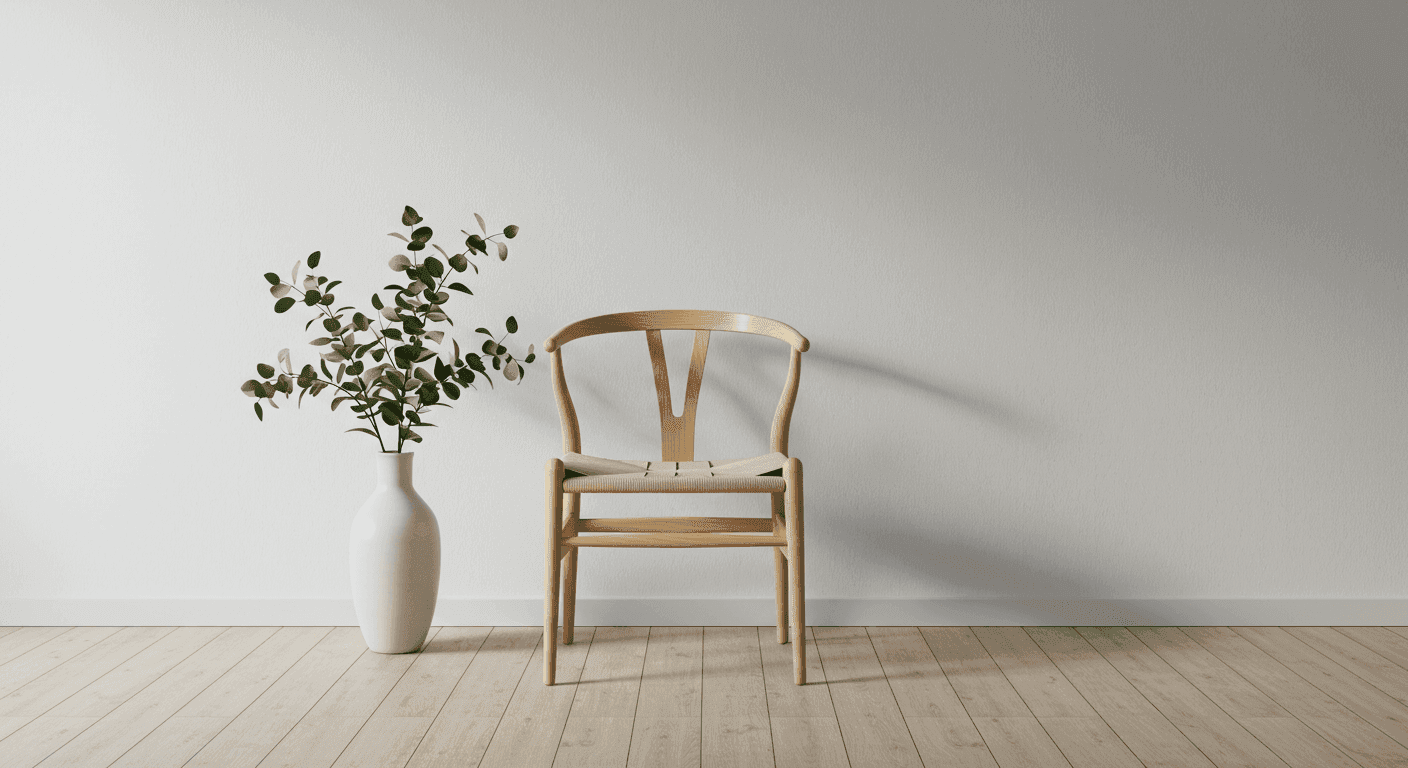
Carl Hansen & Søn has made Hans Wegner's chairs without a break since 1950, and that unbroken run is why the CH24 Wishbone is evergreen on Whoppah. The workshop was founded in 1908 in Gelsted, stayed small until Holger Hansen took over in 1949 and began the Wegner partnership, and is still family-owned on the island of Fyn, now in the third generation. A genuine 1960s Carl Hansen Wishbone sells here at €500 to €1,000; a convincing Vietnamese or Indian copy at €80 to €200. Our curators check the underside disc closely, because the design has been faithfully reproduced for decades and the older productions hold their value differently.
Carl Hansen & Søn was founded in 1908 in Gelsted, Denmark, by Carl Hansen. The company started as a small joinery workshop, and stayed small until 1949, when Carl's son Holger Hansen took over and began the partnership with Hans Wegner that would define the company. The CH24 Wishbone chair, designed by Wegner specifically for Carl Hansen, went into production in 1950 and has never gone out. Carl Hansen has produced the entire CH series of Wegner chairs continuously since then.
The company is still family-owned (now in the third generation under Knud Erik Hansen) and still based on the island of Fyn. They've expanded the catalogue beyond Wegner to include Børge Mogensen, Kaare Klint, Tadao Ando, Naoto Fukasawa, and a few other contemporary designers, but the Wegner CH series remains the heart of the company.
How do you recognise an authentic Carl Hansen & Søn chair?
What to look for on the secondhand market: every authentic Carl Hansen piece carries a metal disc on the underside of the seat frame, branded "Carl Hansen & Søn" with a model number. The disc is the easiest authentication. Some very early pieces from the 1950s and early 60s have a paper label that's worn off; in those cases, the joinery detail and construction quality are the second-best verification.
How do you tell a real Wishbone chair from a copy?
The Wishbone chair (CH24) is the most-imitated piece in this catalogue. The differences between a genuine 1960s Carl Hansen Wishbone (€500 to €1,000 on Whoppah) and a convincing Vietnamese or Indian copy (€80 to €200) reveal themselves in: the bent-frame curve quality (Carl Hansen uses steam-bent solid wood; copies often use laminated bends that show seams), the paper-cord seat tension (Carl Hansen tensions to a specific pattern that holds for 30 to 50 years; copies sag faster), and the underside finish.
Re-corded seats (replacement paper cord) are accepted and normal on a 50-year-old chair. The frame underneath is what determines whether it's a genuine Wegner.