Have it delivered hassle-freeBuyer protectionAll Designer items curated by WhoppahDownload the Whoppah App – get alerts & sell with ease.
Have it delivered hassle-free
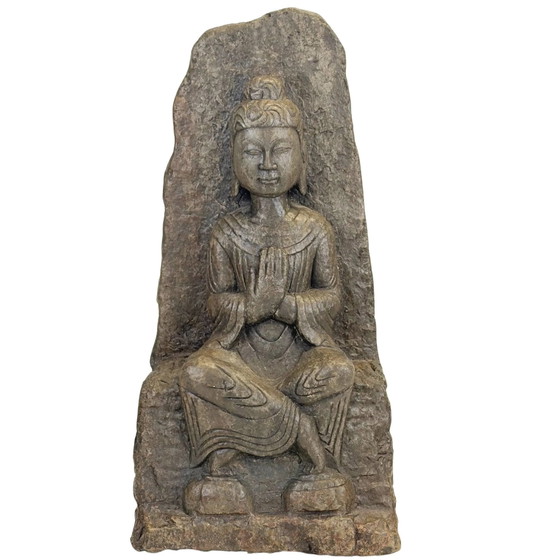
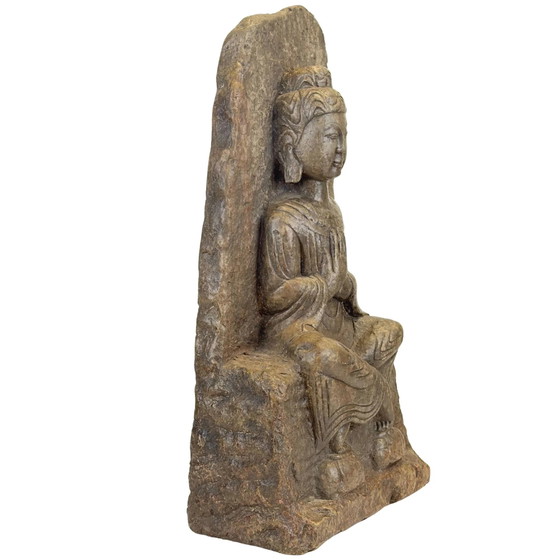
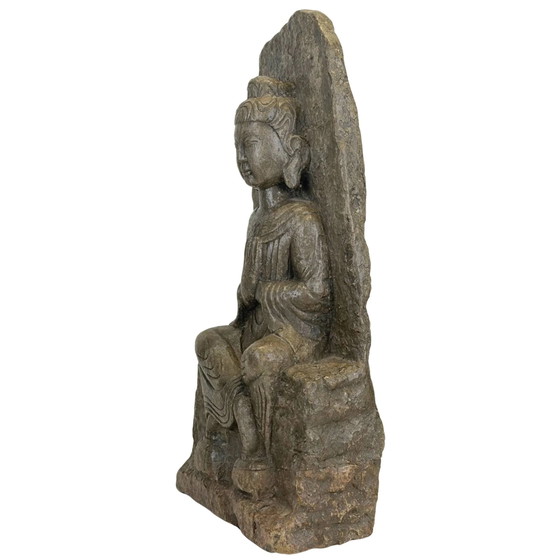
Rare Early Chinese Stone Guanyin (Avalokiteshvara) Stele – Possibly Northern Wei, 5th–6th Century – 45.6 cm
€29,500Bid from €26,550
Buy with confidence
Shop & pay safely with Buyer ProtectionDesigner items curated by WhoppahWe only pay the seller once you have safely received the itemTrusted payment methods


About this seller
Private sellerDamme, GermanyOn Whoppah since February 2025 • 3 sales
Product description
Dimensions: H 45.6 × W 23 cm Weight: 15.5 kg Material: grayish-green fine-grained stone, presumably argillite / argillaceous siltstone Origin: China Subject: crowned Bodhisattva, probably Guanyin (Avalokiteshvara) Dating: possibly Northern Wei / early Northern Dynasties, circa 5th–6th century Provenance: Dutch private collection / Dutch antique trade
Rare early Chinese stone Guanyin stele
This exceptionally heavy Chinese stone stele depicts a crowned Bodhisattva, probably Guanyin (Avalokiteshvara), rendered frontally with hands joined before the chest. The sculpture combines a remarkably archaic sculptural language with a heavily weathered, layered stone surface and constructive details that closely align with the early development of Chinese Buddhist sculpture. The object has been extensively examined visually and microscopically. This involved not only looking at the iconography and style, but also at the rock type, natural damage, carving marks, remnants of the original surface finish, and how the stone reacts after prolonged weathering. The possible dating to the Northern Dynasties period should be considered an attribution. There is no dated inscription or documented early provenance available to establish an exact date of manufacture. The early dating is therefore based on a combination of material-technical observations, sculptural characteristics, and comparison with documented early Chinese Buddhist sculpture.
A remarkably heavy and dense stone
With a height of only 45.6 cm, the stele weighs a remarkable 15.5 kilograms. The sculpture was carved from a solid and very dense block of stone. The stone has a characteristic gray to greenish-gray color and a particularly fine structure. Under magnification, no normal coarse sand structure is visible. The material appears compact and smooth, while the heavily weathered outer skin has become locally brittle and flaky. Based on these properties, the stone is provisionally identified as a fine-grained argillite / argillaceous siltstone, possibly with chloritic components. A definitive petrographic identification would require laboratory research.
Examination of loose stone fragments
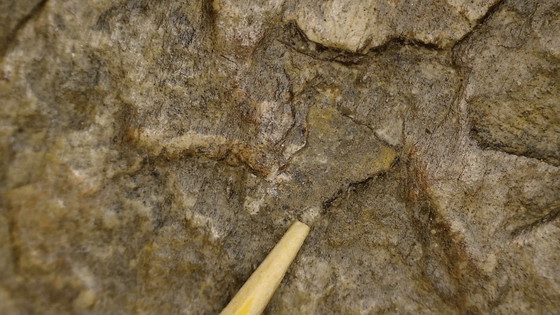
In an already damaged and severely degraded area, it was found that a very small superficial stone fragment could detach with minimal mechanical pressure. This provided an interesting opportunity to examine the material without further treating the intact surface. The fragment showed no sandy granular structure but broke off as a thin, compact, and brittle flake. This behavior is consistent with the fine-grained and somewhat layered structure visible elsewhere on the stele. A loose fragment was also exposed to apple cider vinegar as a simple indicative carbonate test. No visible effervescence occurred. This makes a strongly calcite-rich common limestone less likely. The test is purely indicative and is not a substitute for petrographic or mineralogical laboratory research. Furthermore, the extremely thin flakes initially remained floating on the liquid surface. This should not be interpreted as the stone itself having a lower density than water: for very small dry fragments, surface tension and the porous structure of a weathered outer skin can cause this phenomenon.
Natural layering and weathering on the reverse
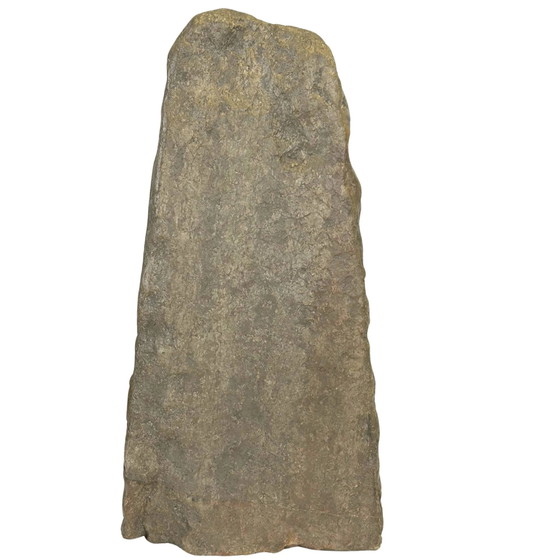
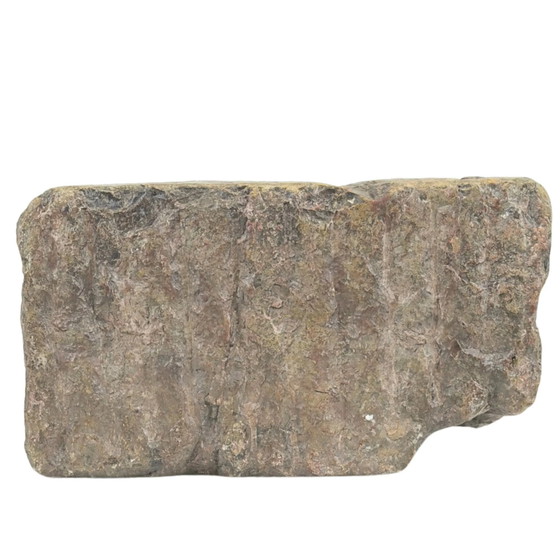
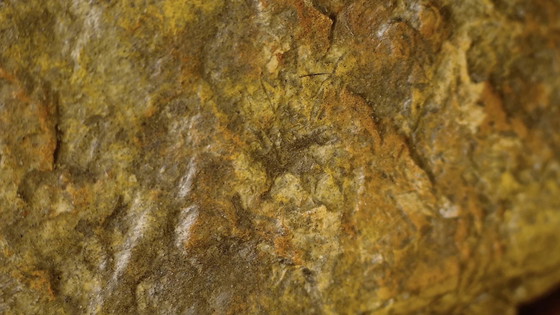
The reverse side is particularly important for assessment. Here, no flat, modern mechanical finish is visible. The surface shows an irregular, undulating, and locally flaking structure, where the natural composition of the rock remains clearly visible. Across the surface, there are dark, gray, greenish, and locally ocher-yellow zones. The ocher-colored areas are consistent with natural iron-bearing weathering products. In depressions, there is a complex accumulation of old surface deposits and weathering material. The combination of a compact core and a locally severely degraded outer skin explains why the object is exceptionally heavy and massive on the one hand, while on the other hand, extremely thin surface flakes are relatively fragile.
Microscopic examination of the carving
Under the microscope, various traces relevant to the manufacturing method are visible. In the more deeply carved sections, irregular manual cutting and working marks are present. The lines are not uniform or mechanically repetitive and follow the modeling of the image. It is also visible that various grooves and worked zones have themselves become part of the weathered surface. The edges are rounded in many places, and the surface deposits extend into the deeper parts of the carving. This supports traditional manual manufacturing and long-term aging of the already sculpted surface. However, it does not in itself constitute an absolute dating: even a later hand-carved sculpture can develop significant natural weathering after sufficient time.
Traces of gold and original surface finish
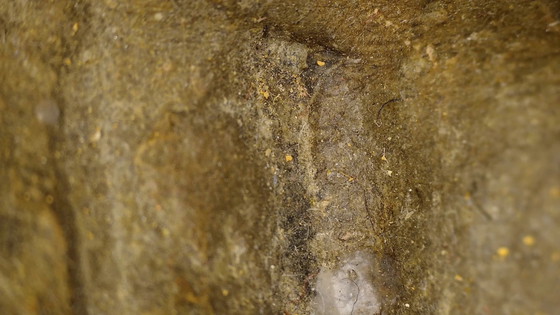
During microscopic examination, small golden-colored remnants were observed in protected depressions. These are not present as a modern uniform layer over the surface, but as small isolated remnants in lower-lying and sheltered zones. This is interesting because early Chinese Buddhist stone sculptures were not necessarily presented as bare stone. Sculptures could be adorned with pigment, plaster-like preparatory layers, and gilding. The present golden-colored remnants are therefore documented as possible remnants of a historical surface finish. Without material analysis, it is expressly not stated that the detected particles are actually gold or that they originate from the original manufacturing period. However, their location deep within the weathered surface makes them relevant for further investigation.
The two separate lotus supports beneath the feet
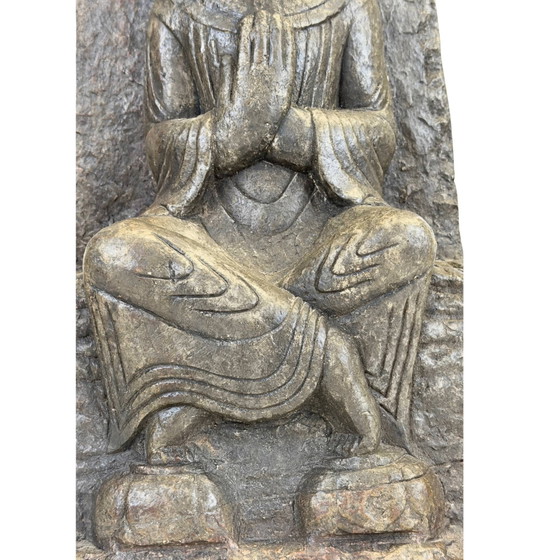
One of the most distinctive iconographic details is located at the very bottom of the figure. The feet do not simply rest on a single continuous plinth. Beneath the left and right foot, there is a separately raised, rounded element. Due to heavy wear and weathering, the original details have partially disappeared, but both forms were deliberately arranged symmetrically. Our current interpretation is that these are likely two stylized lotus footrests. This detail is important because such constructions indeed appear in early Chinese Buddhist sculpture. For example, in the scholarly documentation of the Yungang Grottoes, Cave VIII describes a crowned Bodhisattva seated on a multi-layered throne while both feet rest on a lotus before the figure. Elsewhere in the same grotto, a Bodhisattva is described on a chair-like plinth with a separate lotus footrest below. The supports of this sculpture are not identical to any specific Yungang example. The comparison is therefore typological: it demonstrates that the unusual construction beneath the feet belongs within the formal vocabulary of early Chinese Buddhist sculpture.
Archaic sculptural features
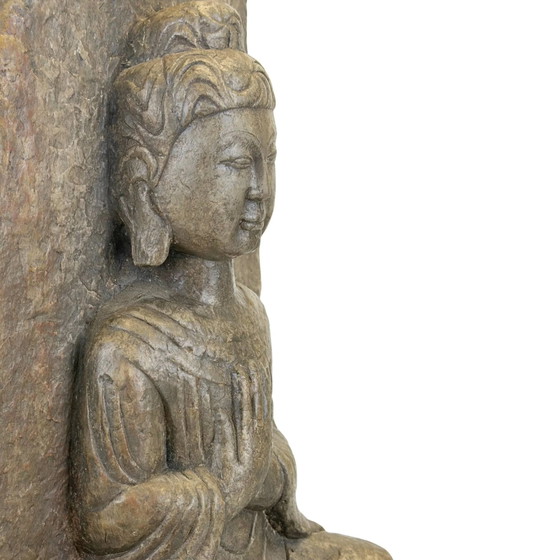
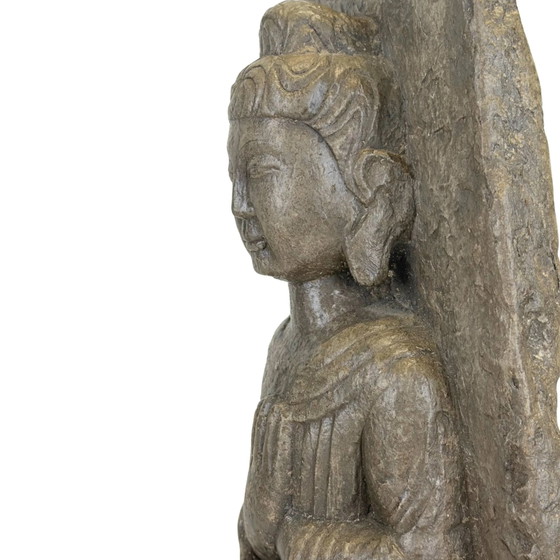
The rest of the composition also possesses features that suggest a possible early dating. The figure is strongly frontal in its composition. The face is relatively broad and serene, with elongated eyes, a simple nose, small mouth, and a controlled smile. The head is crowned by a pronounced crown or coiffure, whose individual volumes are powerfully carved from the stone. The drapery is not rendered naturalistically as in many later sculptures. The folds are largely formed by deep, rhythmic, and parallel lines. This creates a graphic treatment of the robe that strongly contributes to its archaic character. The hands are brought together before the chest in Anjali Mudra, the gesture of reverence, devotion, and spiritual greeting. The combination of crown, elaborate clothing, and Bodhisattva iconography makes an identification as Guanyin / Avalokiteshvara plausible, although the absence of a clearly distinguishing attribute means that this identification cannot be absolutely established.
Comparison with the early Chinese Buddhist tradition
The sculpture exhibits multiple characteristics that invite its examination within the artistic tradition of the Northern Dynasties and subsequent early Chinese Buddhist periods. Especially relevant here are the frontal composition, the archaic facial modeling, the linear treatment of the drapery, the crowned Bodhisattva form, the seat construction, and the lotus-like footrests. Scholarly documentation of the Yungang Grottoes shows that in early Chinese Buddhist sculpture, there was a surprisingly wide variation in seats, footrests, lotus pedestals, and Bodhisattva postures. Therefore, the unusual substructure of this stele should not automatically be considered a later deviation.
Dating and alternative interpretation
The most interesting working hypothesis is currently a manufacture during the Northern Dynasties, possibly Northern Wei, circa 5th–6th century. However, such an early dating cannot be considered definitive without an inscription or old documented provenance. During the assessment, a significant alternative possibility was therefore deliberately considered: a later Chinese archaizing sculpture that consciously harks back to the visual language of the Northern Wei and other early dynasties. Precisely for this reason, no single characteristic is decisive. The current attribution rests on the overall picture of rock type, weight, natural weathering, manual working, microscopic surface characteristics, possible historical finish remnants, iconography, seat construction, and comparative art historical material.
Condition
The stele is in a heavily weathered archaeological condition. There is wear, old damage, material loss, erosion, and localized active surface decohesion. Especially some outer stone layers are fragile and can flake locally. This condition forms an essential part of the object's historical character. Further mechanical cleaning is discouraged. Due to local flaking, professional conservation assessment is preferred before any consolidation material is applied.
Research conclusion
This heavy grayish-green stone stele is a remarkable object of study where material-technical and art historical characteristics converge. The weight of 15.5 kg, the compact fine-grained stone, the negative indicative acid test, the natural layered fracture and weathering structure, manual working marks, possible old gold remnants, and the unusual double lotus footrests collectively support the conclusion that we are dealing with a traditionally manufactured and considerably weathered Chinese Buddhist sculpture. The iconography and sculptural language justify further research into a possible origin during the Northern Dynasties, possibly Northern Wei, 5th–6th century. Due to the lack of a dating inscription and conclusive early provenance, this period is expressly stated as an attribution and not as an absolute dating. An exceptional and enigmatic piece of early Chinese Buddhist sculpture, where precisely the combination of archaic design, heavy stone, original surface traces, and unusual iconographic details makes the object particularly interesting for further study.
Additional details:
- Brand: 1stbuddha
- Style: Vroege Chinese Boeddhistische
- Material: argilliet
- Material: argillaceous siltstone
- Colour: grijsgroen
- Colour: donker
- Colour: groenachtig
- Colour: okergeel
- Period: 5e–6e eeuw
- availability: in_stock
- product_type: Beeld / sculptuur
Specifications
CategorySculptureConditionGoodColorsGreyMaterialStoneSeller locationDamme, GermanyDelivery optionsDelivery or pickup
Discover more
Seller information
About this seller
Private sellerDamme, GermanyOn Whoppah since February 2025 • 3 sales