Have it delivered hassle-freeBuyer protectionAll Designer items curated by WhoppahDownload the Whoppah App – get alerts & sell with ease.
Have it delivered hassle-free
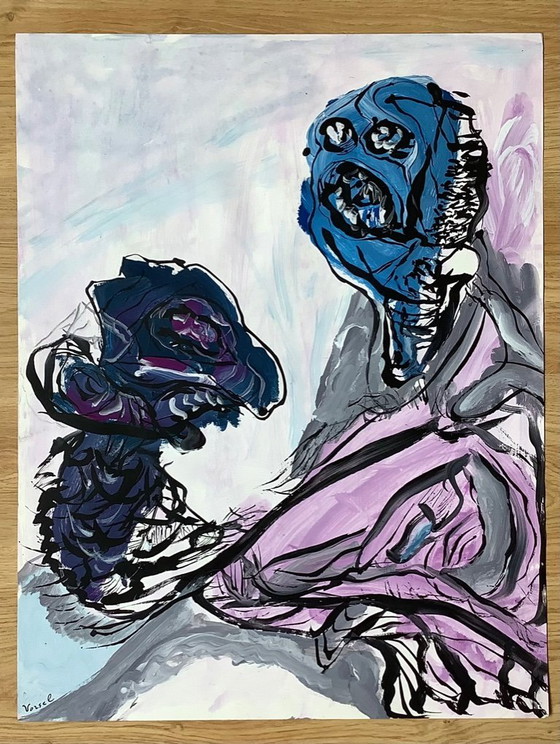
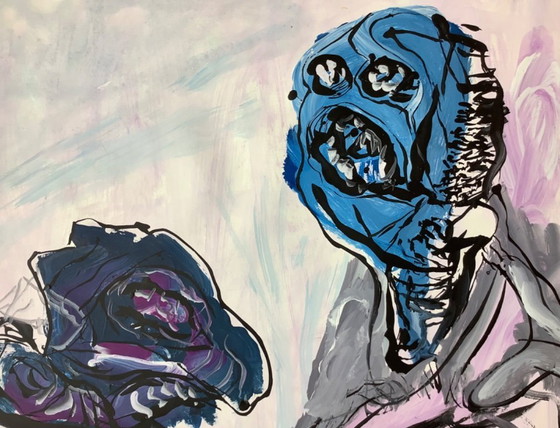
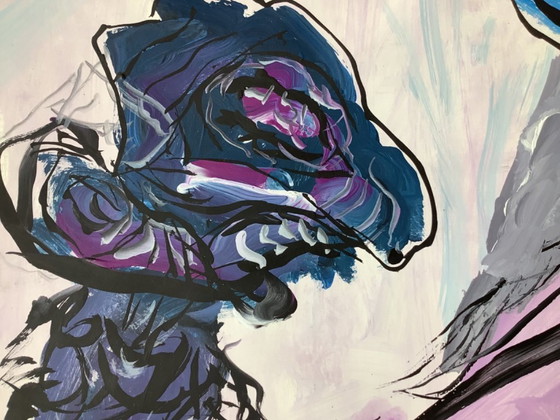
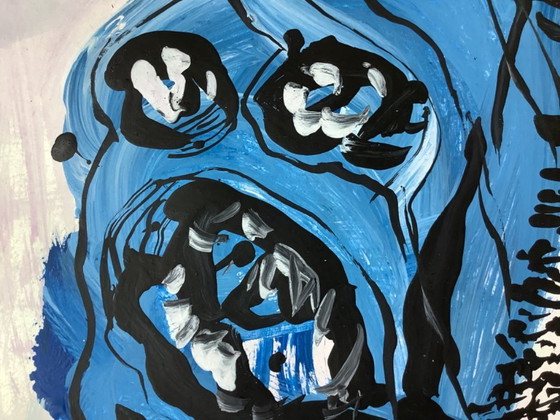
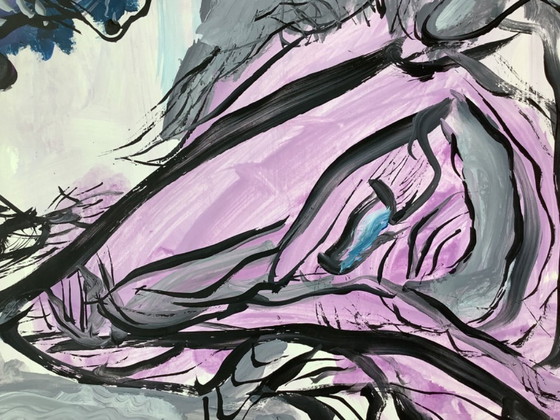
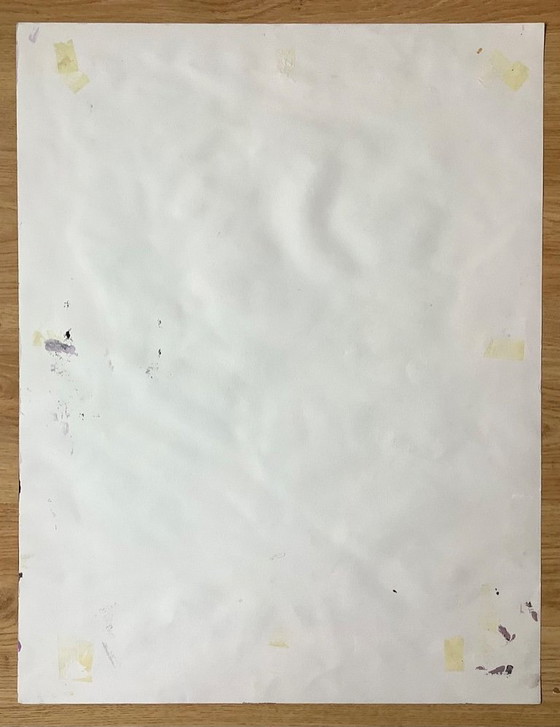
Olav Vorsel Original painting on paper.
€75€67-11%Bid from €45
Curated
Buy with confidence
Shop & pay safely with Buyer ProtectionDesigner items curated by WhoppahWe only pay the seller once you have safely received the itemTrusted payment methods


About this seller
Private sellerBergen op Zoom, NetherlandsOn Whoppah since January 2022 • 64 sales
Product description
Olav Vorsel
Year: 1980-1990
Edition: Original
Title: Two Figures
Technique: Acrylic on paper
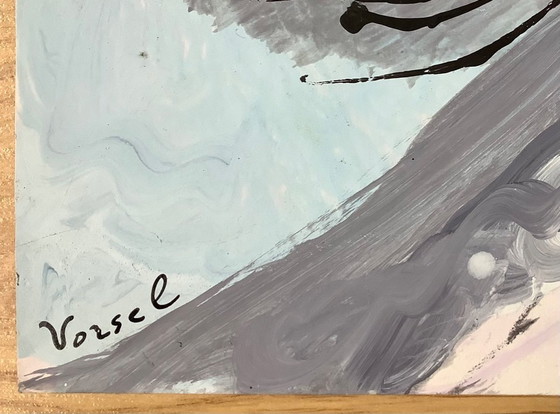
Signed: bottom left
Image dimensions: 65 x 50 cm
Condition: In good condition.
Olav Vorsel (Helmond 1922 - Amsterdam 2007).
Until his 60th year, only a handful of established facts are known about Guus van Rijckevorsel. Born in 1922 in Helmond into the Catholic patrician family Van Rijckevorsel, he spent his youth in Vught. He attended the gymnasium of the minor seminary in Heeswijk-Dinther; it is unknown whether it was actually his intention to be trained as a priest. What is certain, however, is that during his time at boarding school, an intensely experienced sense of emotional neglect developed within him. Add to this the trauma caused by witnessing barbaric acts of war up close during his adolescence, and it explains what made him such a critical, almost audacious observer of society later in life. The direct consequence was that he broke away from the Catholic environment in which he grew up. He enrolled in philosophy and psychology studies at the universities of Dublin, Edinburgh, and Leuven. His final thesis, ‘The Dictatorship of the Ideal’, was never completed.
In 1950, he started working for Van Ditmar in Amsterdam, the then importer of foreign books, newspapers, and magazines, where he would eventually end up as director in the late 1960s. Under his leadership, the publishing arm of Van Ditmar was revitalized; a number of excellent translations of world literature were published. Van Ditmar also presented itself at the annual Frankfurt Book Fair and Distripress conferences. Managing an internationally oriented firm during a time of acquisitions and mergers demanded much from the man who actually wanted the peace and quiet to be able to write. Initially, he found that peace during weekends, when day and night were reversed so that, at night and without the slightest sound, he could concentrate on committing thoughts to paper. Not essays, but short snippets of thought surfaced in an indomitable search for himself. As if it were a shopping list, meant not to be forgotten and possibly later developed into a poem or a readable article. During weekly visits to psychoanalyst Prof. Dr. P.Th. Hugenholtz, who became a friend over the years, these thoughts were discussed and interpreted. In the 1980s, two poetry collections were self-published. Guus van Rijckevorsel passed away on March 5, 2007, in Amsterdam.
By the late 1960s, practical and financial conditions were such that Van Rijckevorsel could afford to dedicate himself to investigative writing. Curious as he already was about the world around him, he now focuses that curiosity on himself.
Through writing, he begins to apply form and color to his imagination, with the result that an inner necessity forces him to let his new language be the language of the image. These are intensely experienced reactions to his inner world, hurled onto the canvas like sledgehammer blows. Ten years of concentrated work in a home studio on the Prinsengracht in Amsterdam. ... gradually, amidst the musical sounds of Bach, Pergolesi, and Vivaldi, the painter Olav Vorsel is born. His then-wife Antoinette supported him by starting the Artes gallery in the basement and selling his oil paintings, gouaches, and drawings there. In 1981, he held his first exhibition in Paris.
From 1969 onwards, Guus van Rijckevorsel devotes himself entirely to his artistry. Initially, primarily as a writer. In the course of the 1970s, his painting style emerges. With this, the painter Olav Vorsel is born. The first dated works date from 1979. He worked from the late seventies until the beginning of the 21st century. Eventually, his physical and mental health declined steadily. This made working no longer possible for him. He had worked as a painter for over 35 years.
The works that Olav Vorsel created during that period were only partially documented during his lifetime. In the eighties, several dozen works were sold, and some were given to friends as a token of gratitude for their help. His works consist of paintings, gouaches, and drawings. These were stored in his studio on the Prinsengracht in Amsterdam.
After the visual artist's death in 2007, the works were put into storage. In 2020, work began on creating an inventory. At that time, his oeuvre comprised over 470 paintings, approximately 300 gouaches, and more than 700 drawings and preliminary studies.
In 2023 and 2024, a gradual start was made with the sale of his work on the national and international art market. The Three Phases in His Work
Art historians recognize three phases in the work of visual artist Olav Vorsel, pseudonym of A.O.M.C. (Guus) van Rijckevorsel (1922-2007). He was surprised that others compared his early work to that of the Cobra group. Therefore, he decided to start reading about modern painting. Through increasing knowledge and under the influence of conversations with other artists, he developed a completely different style. Over the years, the forms become increasingly tighter and, eventually, even applied with mathematical balance.
First Phase
The first phase, from the early 1970s, is identified by experts as Vorsel’s ‘wild phase’: he paints out of his own hand, everything on and over each other, inspired by Cobra, and certainly not serenely.
They possess the primitive, turbulent, colorful energy of a young and driven artist who, in an almost naive urge for self-expression, is willing to explore everything. That was also how he approached life. This work is best documented by his then-wife, Antoinette Alberda.
Second phase
The second phase begins in the mid-1980s and focuses on searching for and developing a personal style.
Quiet images, more fixed forms, colors become calmer. Themes appear unambiguous; the time spent with his girlfriend Adrienne is clearly expressed.
Third phase
The third phase is the development into a personal – abstract – style. This period runs until 2002, during which more visual language for the spiritual is sought. Perhaps a result of reflection on his adolescent years. Inspiration comes from cathedral architecture: arches, high vertical and intersecting lines, silence, no people.
Mathematical and sleek. More black and white and primary colors. Keyword: transcending. What is the meaning of this style?
This period comes to an end because the artist is struck by Parkinson's disease and dementia. That signifies a slow end to his artistic career. He does design, but he leaves the execution to visual artist Peter van Essen. Under Vorsel's supervision, Van Essen develops his sketches and transforms them into the sleek sculptures, as indicated in the sketchbook.
Specifications
ConditionGoodColorsPurple, BlackMaterialPaperNumber of items1OrientationPortraitArt sizeMediumHeight65 cmWidth50 cm
Discover more
Seller information
About this seller
Private sellerBergen op Zoom, NetherlandsOn Whoppah since January 2022 • 64 sales