Have it delivered hassle-freeBuyer protectionAll Designer items curated by WhoppahDownload the Whoppah App – get alerts & sell with ease.
Have it delivered hassle-free
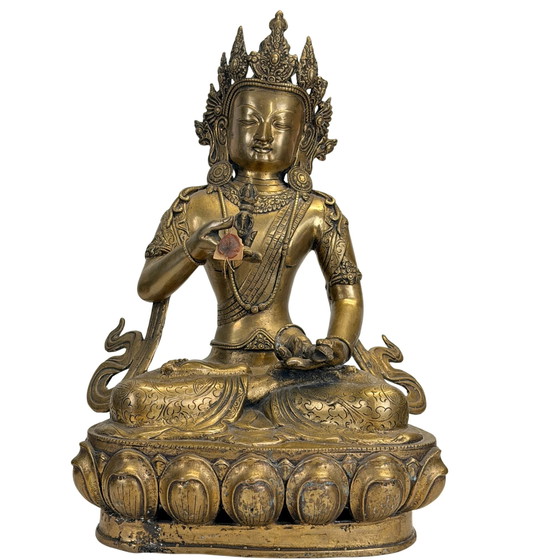
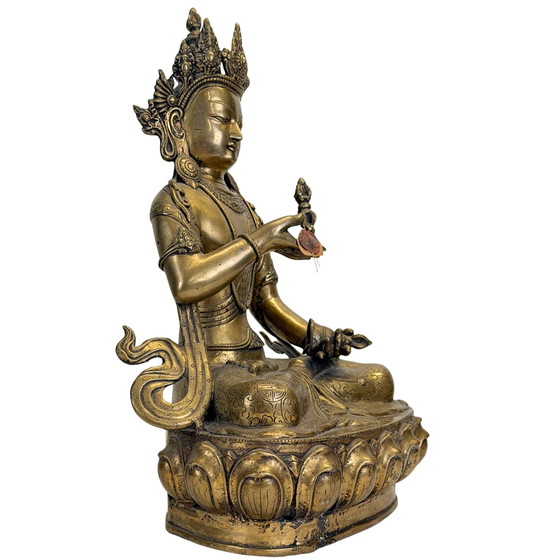
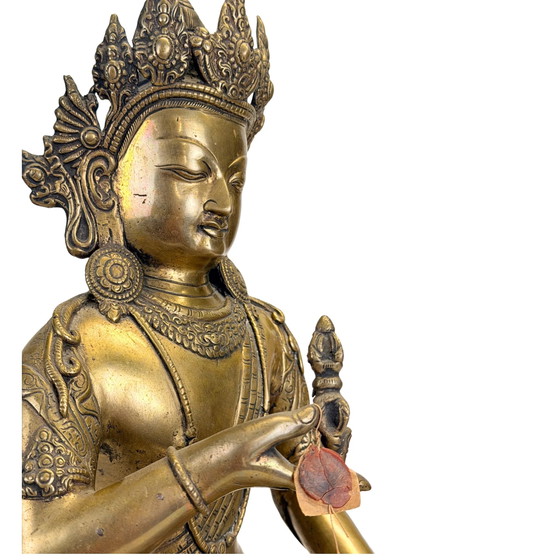
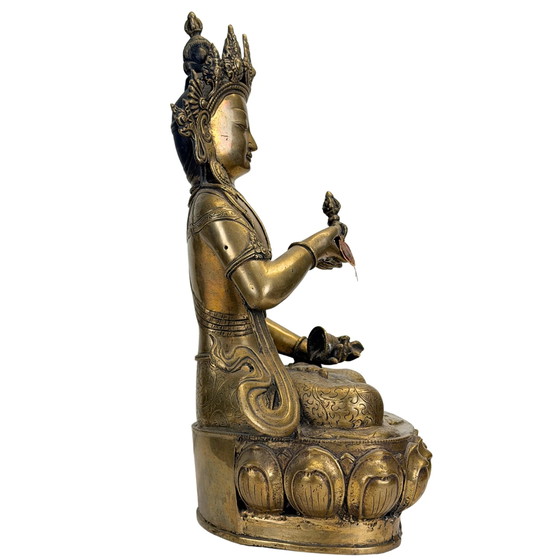
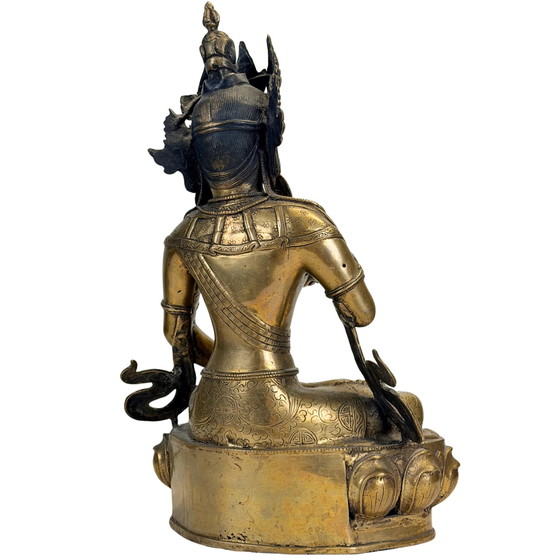
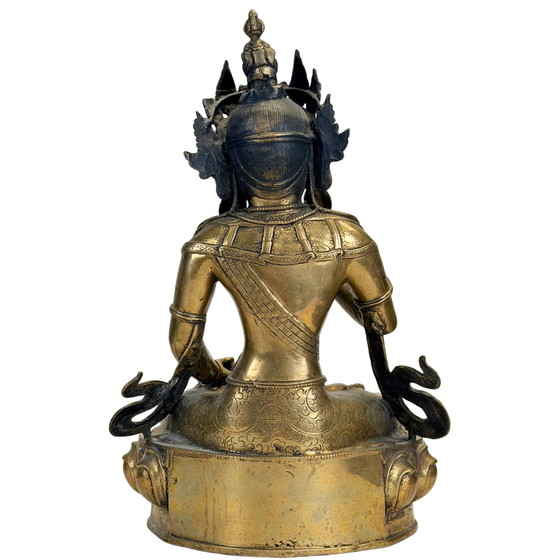
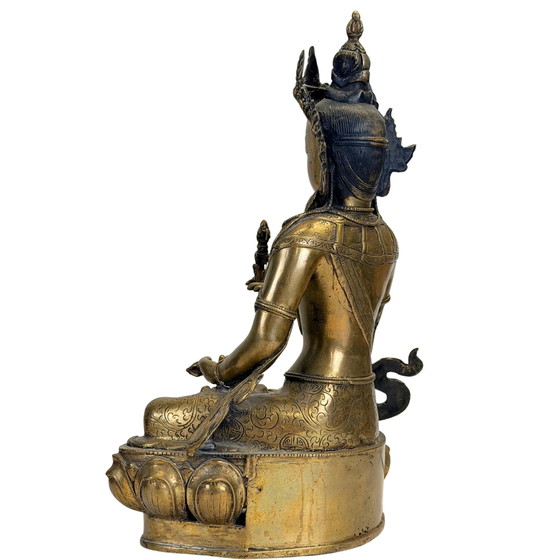
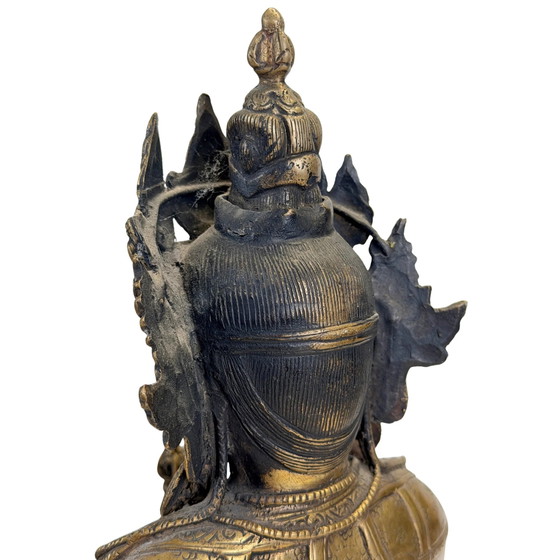
Monumental Tibetan Vajrasattva Statue – Fire-Gilded Bronze with Newar Influence & Nepali Hallmark/Export Seal – 19th Century – 4
€15,500Bid from €13,950
Buy with confidence
Shop & pay safely with Buyer ProtectionDesigner items curated by WhoppahWe only pay the seller once you have safely received the itemTrusted payment methods


About this seller
Private sellerDamme, GermanyOn Whoppah since February 2025 • 3 sales
Product description
Dimensions: H 40.5 × W 27.5 cm
Weight: 5.4 kg
Origin: Tibet / Himalayas, with clear Newar influence
Dating: 19th century
Material: Copper-rich bronze with historical fire gilding
Depiction: Vajrasattva
Provenance: Historical Nepalese assay/export seal, presumably circa 1950–1960
Monumental Tibetan Vajrasattva
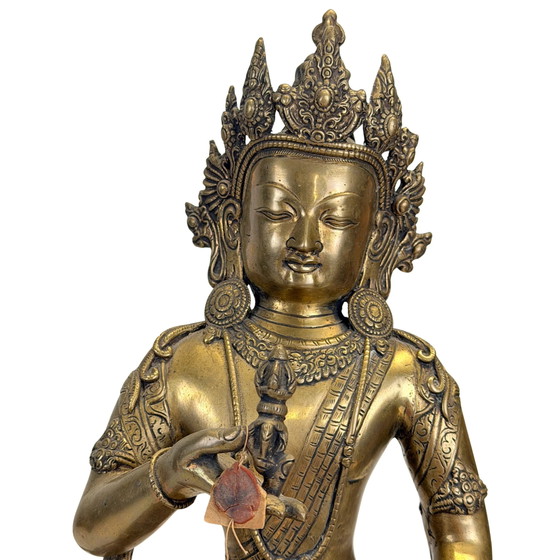
An exceptionally heavy and richly crafted Tibetan bronze sculpture of Vajrasattva, associated within Vajrayana Buddhism with purification, clarity, and the restoration of spiritual purity. With a height of 40.5 cm and a substantial weight of 5.4 kg, this is among the considerably larger and heavier bronze Vajrasattva sculptures. The sculpture combines Tibetan Buddhist iconography with clear Newar influences in the crown, jewelry, body forms, and richly engraved robes. In addition to the stylistic features, the technical condition is particularly interesting. Under magnification, various historical surface layers become visible, including remnants of gilding, wear, old deposits, and oxidation. Furthermore, a small historical Nepalese assay/export seal with its original cord is still attached to the sculpture.
Iconography and Artistic Origins
Vajrasattva – Vajra and Ghanta
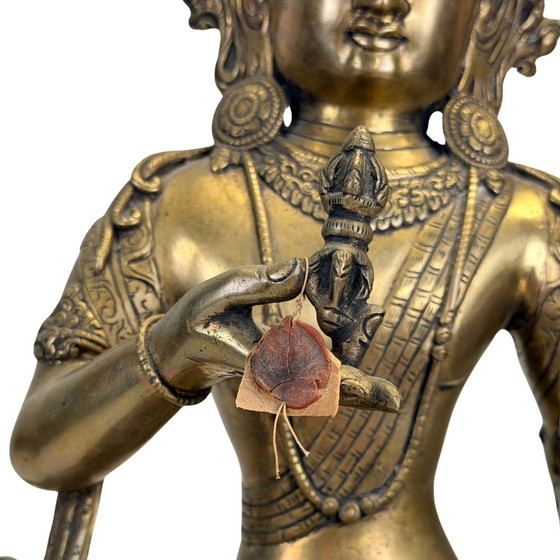
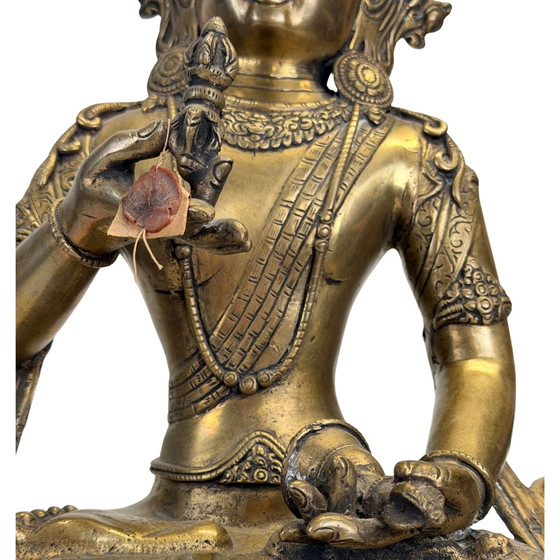
Vajrasattva is recognizable by his traditional ritual attributes. In his right hand, he holds the vajra, the ritual thunderbolt scepter which, within Vajrayana, symbolizes indestructibility and method, among other things. The left hand carries the ghanta, the ritual bell associated with wisdom. The vajra and ghanta together form one of the most important symbolic combinations within Tantric Buddhism. The two attributes refer to the union of method and wisdom on the path to enlightenment.
Tibetan with Strong Newar Influence
The design clearly shows how closely the artistic traditions of Tibet and the Kathmandu Valley were historically intertwined. For centuries, Newar metalworkers from Nepal produced high-quality Buddhist sculptures for Tibetan patrons and exerted a great influence on the development of Tibetan metalwork. In this sculpture, this influence is particularly recognizable in the richly detailed crown, the large round ear ornaments, the graceful body proportions, the jewelry, and the extensive floral engravings on the clothing.
Chinese Influences in the Decoration
Particularly interesting is the combination of Himalayan floral motifs with decorative elements that also recall Chinese iconography. Among the tendrils, there is, among other things, a round medallion motif with a distinct East Asian character. Such a combination does not necessarily mean that the sculpture was made in China. Tibetan Buddhist art developed within an artistic network where Tibetan, Newar, and Chinese stylistic elements were constantly exchanged. Therefore, we primarily consider the sculpture to be Tibetan/Himalayan with strong Newar influence and additional Sino-Tibetan stylistic elements.
Historical Fire Gilding
One of the most important technical characteristics of the sculpture is its historical gilding. Gold-colored surface layers are still present over large areas of the bronze, with clear differences visible under magnification between exposed and protected zones. The observed surface and wear pattern are consistent with traditional fire gilding. In this historical technique, a gold-mercury amalgam was applied to a copper-containing surface and then heated. After heating, a strongly adhering, gold-rich surface layer remained.
Natural Wear of the Fire Gilding
Under microscopic magnification, it is clearly visible how the gold-colored layer on exposed surfaces has gradually thinned, while more intense remnants have been preserved along protected edges, recesses, engravings, and between protruding decorative elements. The transition from the intensely gold-colored remnants to the duller golden-brown substrate is gradual. No clear foil-like edges or peeling flakes are visible, as one might expect with an applied gold leaf layer. Particularly around small decorative edges, the pattern is clear: the protruding parts show wear from use and polishing, while in sheltered areas immediately adjacent, significantly stronger remnants of the original gilding are present.
Gilding under the Microscope
Under strong magnification, the remaining gold-colored layer appears to be intimately bonded to the metal surface. Locally, it has almost disappeared, while a few millimeters further a much more intense gold color may still be present. This uneven distribution is important. A historical surface does not have to exhibit the same color, luster, or degree of oxidation everywhere. High points, deep engravings, sheltered seams, and surfaces that could be touched for generations each have their own surface history. The microscopic observations thus support a historical metallic gilding. However, without elemental analysis, the presence of mercury is not presented as analytically proven independently.
Hand-Engraved Decoration and Craftsmanship
Floral and Geometric Engravings
The clothing and ornaments have been extensively hand-engraved. Large floral tendrils run over the robes, combined with smaller geometric patterns and decorative bands. Under magnification, small differences are visible in the width, depth, and direction of individual lines. These variations are consistent with manual finishing of the cast surface. Dark deposits have accumulated in many of the deeper engravings, while the raised surfaces have become considerably smoother. This now creates a strong contrast that makes the original decoration even more visible.
Surface and Natural Signs of Age
At normal viewing distance, the sculpture presents a strikingly intact and gold-colored appearance. Under the microscope, however, the surface proves to be much more complex. Local scratches, small pits, dark deposits, oxidation, polished zones, and various stages of wear are visible. Some of these traces are deep within hard-to-reach parts of the sculpture, while others appear precisely on the most exposed surfaces. These differences are more relevant for technical research than a uniform dark patina. They show that different parts of the object have reacted under different conditions over a long period.
Historical Nepalese Assay/Export Seal
A unique part of the provenance is the small red Nepalese lac/shellac seal still attached to the sculpture with its old cord. The seal is severely aged and shows dehydration, shrinkage, deep craquelure, and damage along the edges. The old cord and the original attachment have also been preserved. Based on current research and comparison with historical Nepalese assay and export procedures, this type of seal is provisionally placed around the mid-20th century, probably circa 1950–1960.
What the Nepalese Seal Documents
The most important thing is to interpret the seal correctly. Such a seal is not a scientific certificate that automatically determines the exact age of the sculpture. It primarily serves as a historical provenance marker: it documents a moment when the sculpture was already in Nepal and became part of an official assay, administrative, or export procedure there. If the seal and its original attachment indeed date from circa 1950–1960, this provides an important chronological anchor point in the 20th-century history of the sculpture.
Why the Seal Does Not Determine Origin
A Nepalese seal emphatically does not mean that the sculpture must have been made in Nepal. For centuries, Nepal was both an important production center and a crossroads for Buddhist art from across the Himalayas. Tibetan religious sculptures could travel via Nepal, be traded there, or ultimately be exported from Nepal to Europe and other parts of the world. This became even more relevant in the 20th century due to political changes in Tibet and the movement of Tibetan communities and religious objects throughout the Himalayan region. This historical context makes a Tibetan origin, combined with a later Nepalese assay or export history, entirely plausible. Without additional documentation, however, no specific monastic, refugee, or collector provenance is attributed to this individual sculpture.
The Seal as Terminus Ante Quem
When a historical seal can be reliably dated and its original connection to the object is intact, it can function as a terminus ante quem: the sculpture must have already existed before the moment the seal was affixed. This makes the seal valuable for provenance research, but it does not determine whether the sculpture was made in, for example, 1750, 1850, or 1900. The dating of the sculpture itself must be investigated independently. For a more detailed explanation of historical Nepalese assay and export practices, the meaning of red lac seals, and their limitations as dating evidence, see our research article Nepalese Export Seals on Buddha Statues – What Do They Really Prove?
Dating and Technical Research
Dating: 19th Century
Based on the current combination of stylistic and technical characteristics, we cautiously place this Vajrasattva in the 19th century. This assessment takes into account, among other things, the iconography, heavy execution, traditional casting technique, manual finishing, decorative formal language, historical gilding, surface development, and comparison with Tibetan and Newar-inspired Himalayan bronzes. A dating to the 18th century cannot be entirely ruled out based on style alone but is deliberately not presented as certain without stronger comparative or material-technical evidence. We consider the more conservative classification of the 19th century to be the most appropriate at this time.
Microscopic Research
The sculpture has been examined by us using macrophotography and microscopic surface analysis. Special attention has been paid to the gilding, engravings, wear zones, protected surfaces, corrosion, deposits, and the relationship between the various visible surface layers. Microscopy in itself does not yield an absolute calendar date. Its value lies in making visible details that can barely be assessed with the naked eye and in comparing different parts of the same object. In this way, technical observations can be combined with stylistic and historical data, without treating any single characteristic as absolute proof of age.
An Exceptional Tibetan Temple Bronze
The combination of its monumental size, exceptional weight of 5.4 kg, extensive hand-engravings, historical gilding, refined Vajrasattva iconography, and the preserved Nepalese assay/export seal makes this a particularly complete collector's item. Furthermore, the sculpture represents various chapters from the history of Himalayan art. The sculpture itself demonstrates the artistic interplay between Tibet and the Newar tradition, with additional Chinese influences, while the old Nepalese seal forms a tangible trace of the object's later 20th-century journey. A monumental Tibetan Vajrasattva combining Buddhist iconography, traditional metal craftsmanship, historical fire gilding, and a rarely preserved provenance element.
Additional details:
- Brand: 1stbuddha
- Style: Tibetaans
- Style: Himalaya
- Style: Newar
- Style: Boeddhistisch
- Style: Sino-Tibetaans
- Colour: Goud
- Period: 19e eeuw
- availability: in_stock
- product_type: Beeld / sculptuur
Specifications
CategorySculptureConditionGoodMaterialBronze, GoldSeller locationDamme, GermanyDelivery optionsDelivery or pickup
Discover more
Seller information
About this seller
Private sellerDamme, GermanyOn Whoppah since February 2025 • 3 sales