Have it delivered hassle-freeBuyer protectionAll Designer items curated by WhoppahDownload the Whoppah App – get alerts & sell with ease.
Have it delivered hassle-free
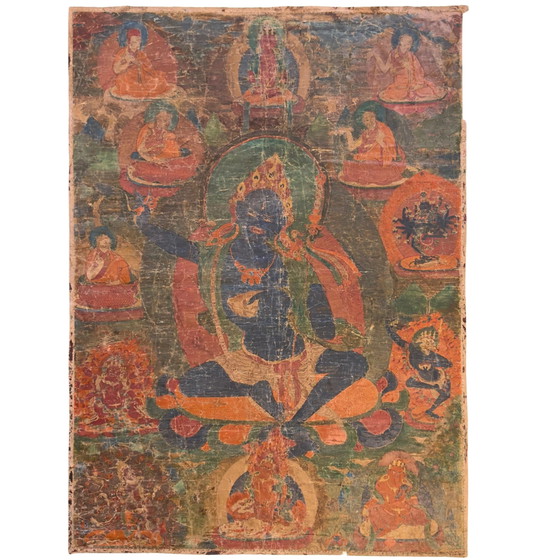
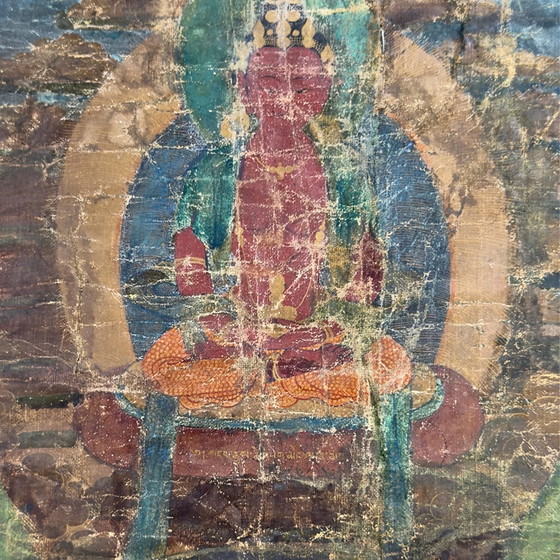
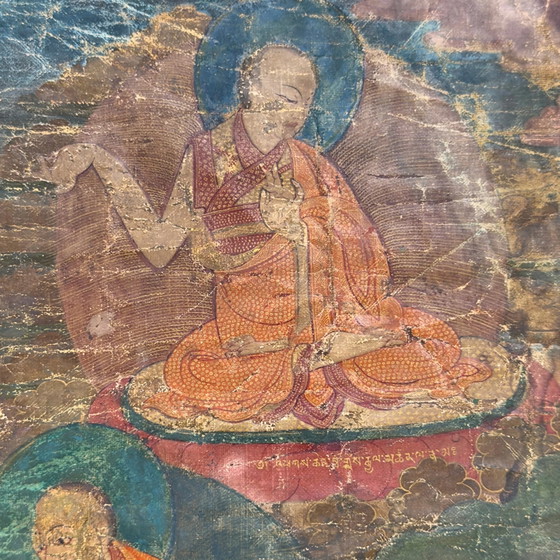
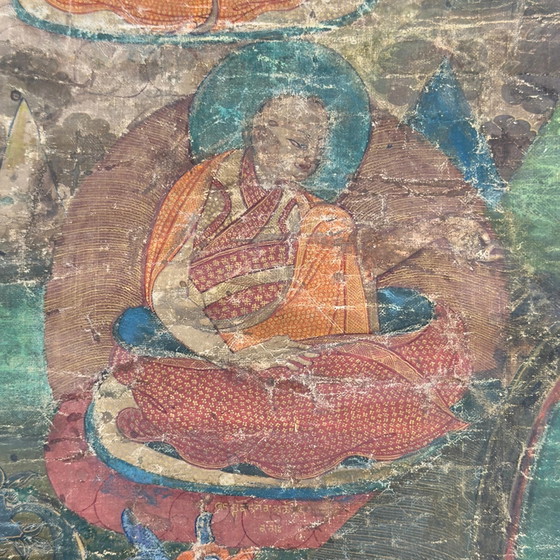
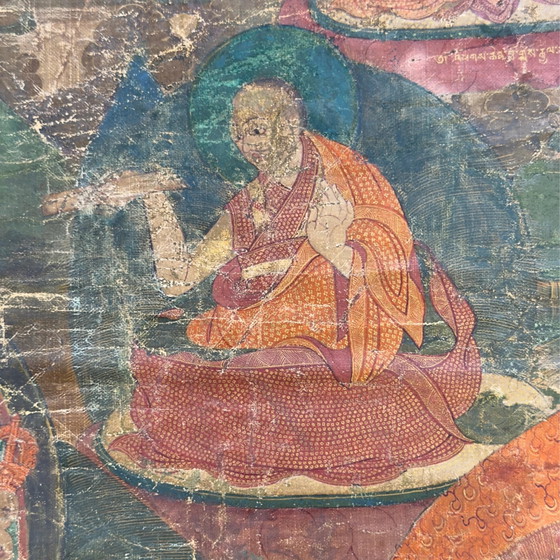
Monumental Tibetan Sakya Lineage Thangka with Hevajra – Early Ngor Tradition, second half 15th century
€49,500Bid from €44,550
Buy with confidence
Shop & pay safely with Buyer ProtectionDesigner items curated by WhoppahWe only pay the seller once you have safely received the itemTrusted payment methods


About this seller
Private sellerDamme, GermanyOn Whoppah since February 2025 • 3 sales
Product description
15th-Century Tibetan Sakya Lineage Thangka with Hevajra – Early Ngor Tradition (c. 1450–1490)
**Dimensions**
Height: 89.5 cm
Width: 65 cm
Original Brocade Mounting: No longer present
This exceptional Tibetan lineage thangka is undoubtedly one of the most remarkable religious artworks we have examined in recent years. Over several months, this piece was art-historically studied based on iconography, historical Tibetan inscriptions, a complete translation of the colophon on the reverse, identification of the depicted masters, analysis of the ritual Rañjanā inscriptions, and comparison with known examples from the Sakya and Ngor traditions. All investigated elements remarkably and consistently point in the same direction: a high-quality lineage thangka from the early Ngor tradition of the Tibetan Sakya school, likely produced during the second half of the fifteenth century.
**An Exceptional Religious Painting**
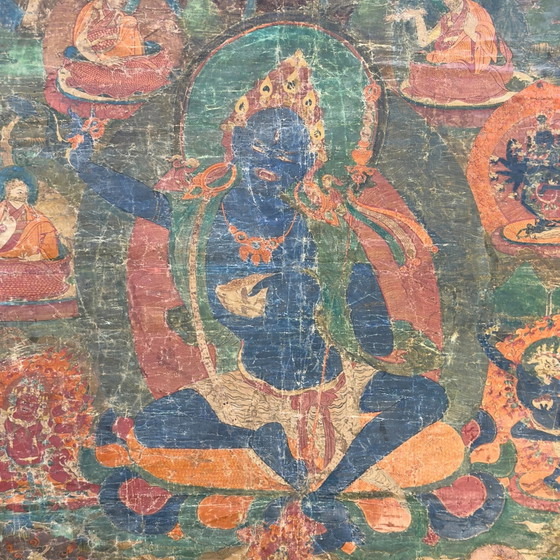
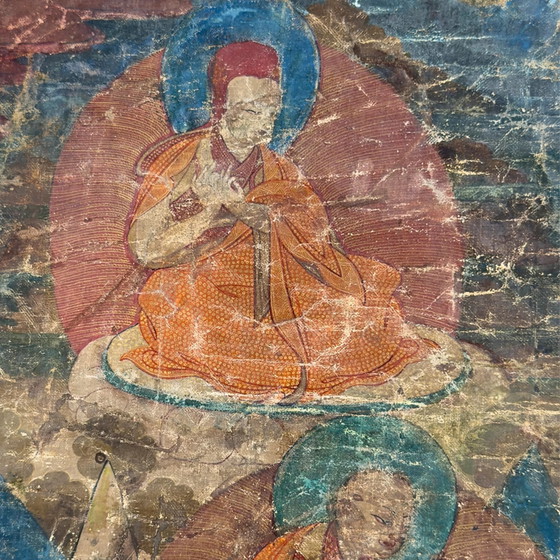
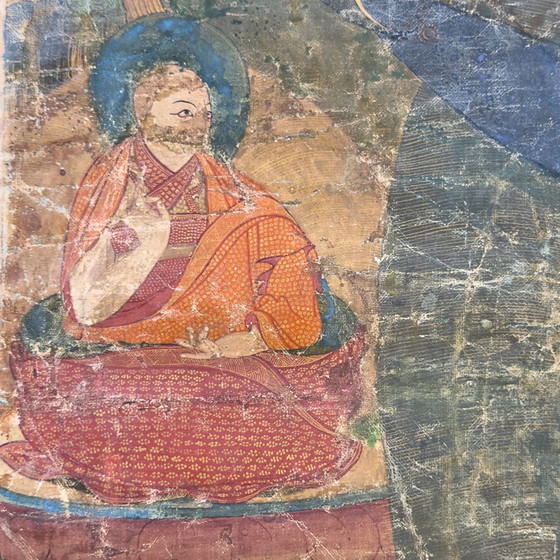
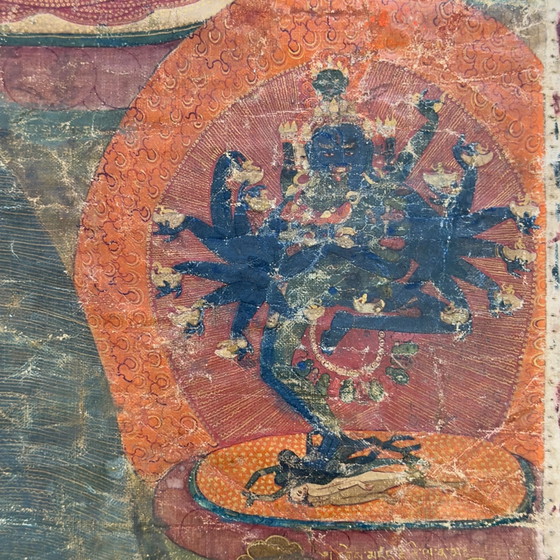
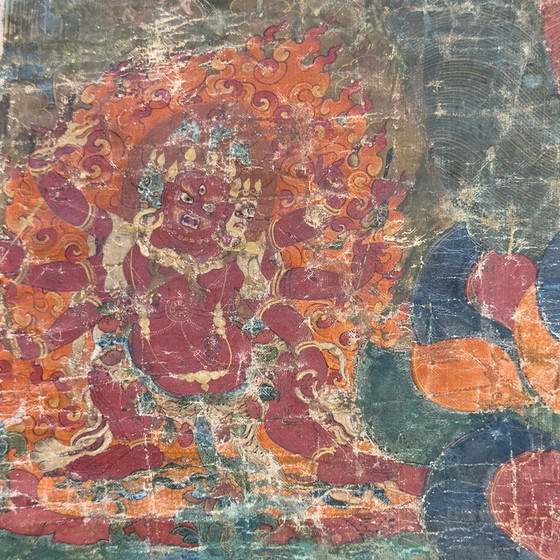
Central to the composition is Hevajra, one of the most important meditation deities within the Lamdré tradition of the Sakya school. Surrounding the central depiction are historical masters, protector deities, dākinīs, and wealth deities, carefully arranged according to a religious program that visualizes the spiritual transmission of the tradition. Among the main figures are extremely refined golden Tibetan inscriptions. During the research, the following historical figures, among others, could be identified:
* Chögyal Phagpa
* Lodrö Gyeltsen
* Zhangtön Könchok Pel
* Nyenchen Sönam Tenpa
* Ngorchen Kunga Zangpo
Additionally, several important deities were identified, including Amitāyus, Hevajra, Brahmarūpa Mahākāla, Siṃhamukhā, Jetsün Dagmema, Vaiśravaṇa, and Jambhala.
**Historical Colophon**
The entire reverse side of the thangka features an extensive Tibetan colophon. The text contains traditional Buddhist verses, wish prayers for the dissemination of the Dharma, references to the Lamdré tradition, and explicitly names the patron Dzözin Gyeltsen Rinchen. Thus, the reverse side constitutes an exceptionally valuable historical source that directly connects to the lineage depicted on the front.
**Rañjanā Consecrations**
In addition to the Tibetan colophon, the reverse side contains several ritual inscriptions in the classical Rañjanā or Lantsa script. These ceremonial Sanskrit inscriptions are placed precisely behind the main figures, indicating that this thangka was fully ritually consecrated. The combination of an extensive colophon, historical names, and ritual reverse inscriptions is rarely found.
**Art-Historical Research**
During the investigation, multiple independent lines of research were pursued in parallel. Not a single observation alone formed the basis for the final conclusion, but rather the sum total of all available data:
* Complete iconographic analysis.
* Identification of the historical lineage.
* Translation of the Tibetan colophon.
* Translation of the golden inscriptions.
* Analysis of the ritual Rañjanā inscriptions.
* Examination of the fabric, painting style, and composition.
* Comparison with known Sakya and Ngor traditions.
Based on these combined research results, we conclude that this thangka can be convincingly attributed to the early Ngor tradition of the Sakya school and was likely produced during the second half of the fifteenth century.
**Condition**
The thangka is in honest, authentic condition, befitting a religious artwork of considerable age. The original brocade mounting is missing, while the painted canvas shows natural wear, craquelure, paint loss, and signs of use consistent with prolonged religious use and centuries of preservation. These very characteristics underscore the authentic nature of the object.
**Research Dossier**
An extensive research dossier is available for this thangka, containing the complete art-historical analysis, translations, iconographic identifications, and reconstruction of the historical lineage. This dossier forms an important part of the object's documentation and will be further expanded in the future as new comparative material becomes available.
**Specifications**
Object: Tibetan Lineage Thangka
Tradition: Sakya – Ngor
Religious Cycle: Lamdré
Central Deity: Hevajra
Period: Likely second half 15th century (c. 1450–1490)
Origin: Tibet
Material: Handwoven canvas with mineral pigments and gold decorations
Condition: Authentic historical traces of use commensurate with age.
Want to know more? An extensive research dossier has been published on analyzing this thangka step-by-step, including the complete translation of the Tibetan colophon, the identification of the depicted masters, and the reconstruction of the historical Lamdré lineage.
**Religious Significance**
This thangka was not created as a decorative artwork but as a religious instrument for meditation, the transmission of knowledge, and ritual practice within the Vajrayāna tradition. Each depicted figure has a fixed place within the spiritual structure of the painting. Together, they do not form a collection of separate deities, but a carefully constructed visual map of the Lamdré tradition as it was transmitted within the Sakya school. Central is Hevajra, the most important meditation deity of the Lamdré tradition. Surrounding him are historical lineage masters, protectors of the dharma, female wisdom deities, and deities associated with prosperity, protection, and spiritual development. Thus, the thangka functioned not only as an object of veneration but also as a visual aid during initiations, meditations, and the oral transmission of teachings.
**Artistic Quality**
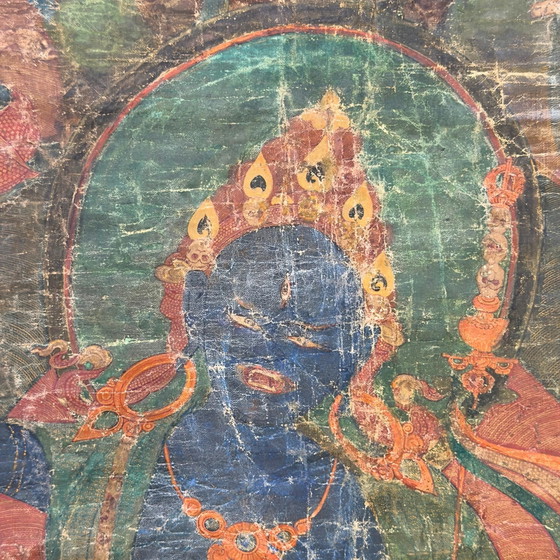
Apart from its religious significance, the exceptional artistic quality is immediately apparent. The painter worked with remarkable precision that remains visible even under strong magnification. The faces are individually detailed, the robes are built up from hundreds of extremely fine brushstrokes, and the gold decorations precisely follow the contours of the clothing without visibly bleeding. The composition also reveals an experienced master. Despite the large number of figures, the painting never appears overcrowded. Each master and each deity has a logical place within the whole, naturally guiding the viewer along the spiritual transmission line. This level of planning and execution is among the highest quality in Tibetan painting.
**The Canvas**
One of the first observations during the research was the exceptionally thin support on which the painting is executed. Due to its fine structure, it initially even gave the impression that the depiction was painted on paper. Only upon closer inspection did it prove to be a very finely woven textile. The canvas possesses a remarkably regular weave structure and forms an excellent ground for the extremely detailed painting. The paint layer is deeply absorbed into the fibers and shows natural aging that perfectly matches the wear of the textile itself. No evidence was found that the painting was applied to an older support at a later time.
**Mineral Pigments and Gold**
The colors are dominated by deep blues, intense reds, various shades of green, and extensive gold decorations. These pigments exhibit natural aging that has developed a rich depth over the centuries. Particularly the gold work is executed with exceptional refinement and is used to detail robes, aureoles, jewelry, and decorative patterns down to the smallest elements. Under magnification, it is visible that the gold lines were not applied mechanically but entirely painted by hand. Many patterns consist of microscopically small dots, lozenges, and floral motifs that only a highly experienced artist could have executed.
**Conservation**
As with almost all religious thangkas of considerable age, this example also shows signs of use. Minor paint losses, craquelure, creasing, and wear are visible across the entire surface. These characteristics are not unusual but rather constitute an important part of the object's history. They reflect centuries of ritual use, transport, storage, and natural aging. Despite these signs of use, the iconography is excellently preserved. The historical inscriptions are largely legible, the composition is completely intact, and the main religious and art-historical features have been exceptionally well preserved.
**Rarity**
Lineage thangkas of this quality belong to the rarest categories within Tibetan painting. Even more exceptional is an example where the historical masters, the patron, the religious tradition, and a large portion of the original texts could be collectively identified. During this research, it became clear that the painting not only contains a religious depiction but also preserves an exceptional amount of historical information. The combination of the complete colophon, the golden inscriptions, the Rañjanā consecrations, and the carefully constructed Lamdré lineage makes this thangka an important document for the study of the early Sakya and Ngor traditions.
**A Museum-Worthy Research Object**
This thangka represents much more than just a religious painting. It forms a rare combination of spiritual significance, historical documentation, and exceptional artistic quality. Months of research have shown that image, text, ritual, and history converge here in a unique way. For collectors, museums, and researchers, this object offers a rare opportunity to acquire a meticulously documented Tibetan lineage thangka whose religious context, historical background, and art-historical significance have been extensively researched and recorded. Consequently, this painting not only ranks among the finest examples of Tibetan religious art but also among the best-documented objects in our collection.
Additional details:
- Brand: 1stbuddha
- Style: Tibetaanse
- Style: Ngor-traditie
- Material: Doek
- Material: Brokaat
- Colour: Gouden
- Period: tweede helft 15e eeuw
- availability: in_stock
- product_type: Thangka / paubha
Specifications
CategoryPaintings & DrawingsConditionVery goodSeller locationDamme, GermanyDelivery optionsDelivery or pickup
Discover more
Seller information
About this seller
Private sellerDamme, GermanyOn Whoppah since February 2025 • 3 sales