Vintage and secondhand design in Copenhagen: the home market for the canon
Copenhagen is the home market for Danish mid-century design, which means the secondhand inventory is the deepest in the world. Wegner, Jacobsen, Juhl, Mogensen, Kjærholm. Here's the friendly guide.

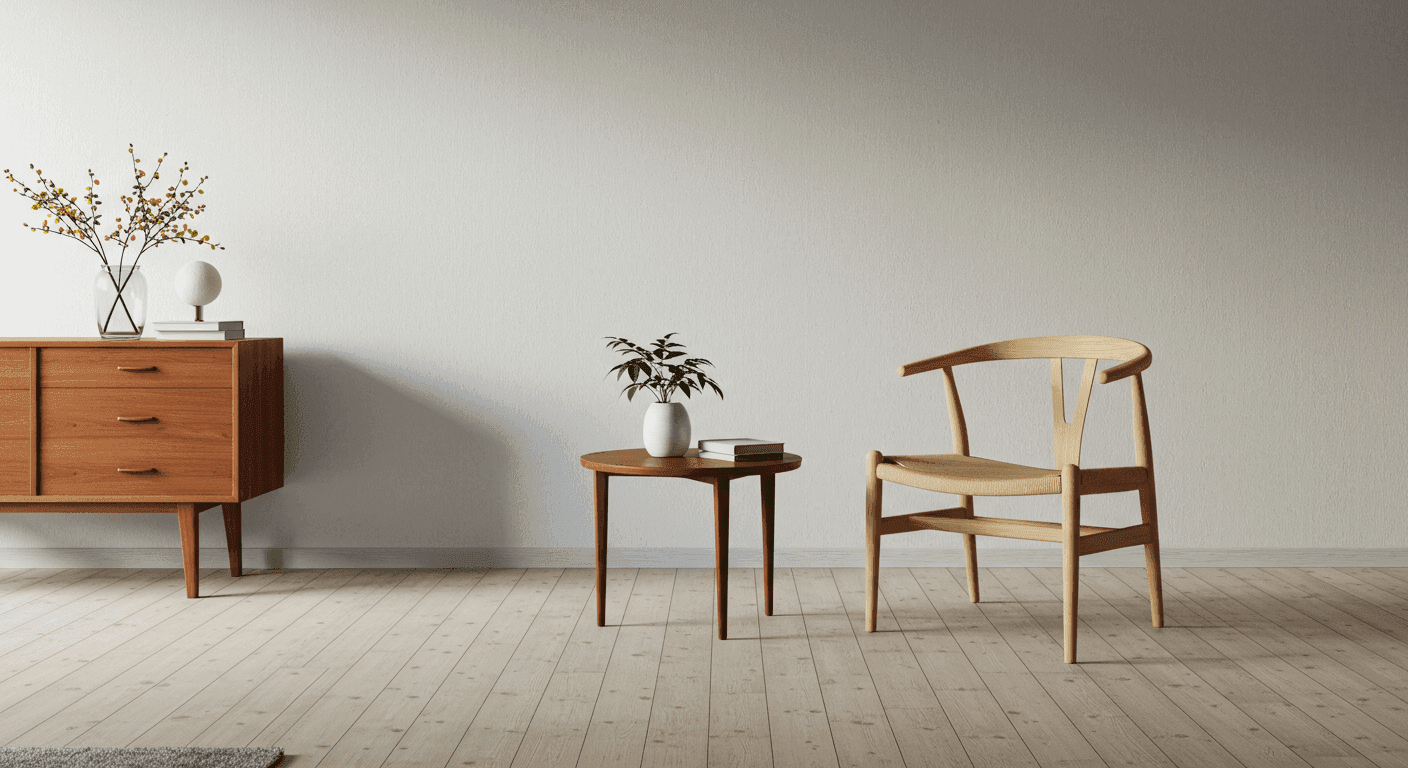
Copenhagen is the world's best market for original-period Danish mid-century, because the pieces were made here and Danish households are still letting them go as generations change. The honest trade-off is that prices are not always lower than Amsterdam or Berlin for the same model; Danish buyers know exactly what these pieces are worth. What you get instead is depth: rare configurations, rare colours and original-condition examples that do not surface elsewhere. On Whoppah, Copenhagen means Wegner at €500 to €4,500, Jacobsen for Fritz Hansen at €250 to €7,000 and Poul Kjærholm at €1,800 to €8,000. It is also the hardest market for us to source from, because Danish sellers keep their good pieces longer.
Why is Copenhagen the best market for Danish mid-century design?
If you want to buy original-period Danish mid-century design (Wegner, Jacobsen, Juhl, Mogensen, Kjærholm, Panton, Bojesen), Copenhagen is the world's best market for it. The pieces were made here, they were sold to Danish households in the 1950s through 70s, and those households are still letting pieces go as generations change. The local supply is unmatched.
The trade-off, which is honest to say, is that Copenhagen prices for these pieces are not always lower than Amsterdam or Berlin prices for the same models. Danish buyers value their own design heritage and the market is competitive. But the inventory depth means rare configurations, rare colours, and original-condition pieces appear here when they don't appear elsewhere.
Whoppah's Copenhagen inventory tends to be deepest in Hans Wegner (across multiple manufacturers), Arne Jacobsen for Fritz Hansen, Børge Mogensen, Verner Panton, Poul Kjærholm, and contemporary Danish (Hay, Muuto, &Tradition, Gubi).
What Copenhagen is known for
I've written separately about Scandinavian Modern as a movement, so this is the short version. Copenhagen was the centre of the Danish furniture industry's golden age (roughly 1945 to 1975). The Copenhagen Cabinetmakers' Guild ran an annual exhibition that pushed every major designer harder than they'd push themselves; the resulting body of work is the canonical mid-century Danish output.
The post-2000 Danish design generation (Hay founded 2002, Muuto founded 2006, &Tradition founded 2010) is also Copenhagen-anchored. The contemporary Danish design ecosystem (designers, manufacturers, retailers, magazines) is concentrated in the city.
Where to see iconic pieces
A few Copenhagen institutions are essential.
The Designmuseum Danmark (Bredgade 68) is the institutional anchor. Comprehensive Danish design collection plus international holdings.
The Louisiana Museum of Modern Art (Humlebæk, 35 minutes north of Copenhagen) has substantial design holdings within its broader art collection.
The Trapholt Museum (in Kolding, 2 hours from Copenhagen) is more design-focused than Designmuseum and worth the trip for serious collectors.
For commercial viewing, the showrooms of Fritz Hansen, Carl Hansen & Søn, Louis Poulsen and PP Møbler are all open to the public in central Copenhagen. The Designer Saturday model in Copenhagen, similar to but smaller than Milan's Salone, happens annually in late summer.
The Danish auction houses (Bruun Rasmussen, Lauritz.com) hold regular Danish-design auctions and the catalogues are educational reading.
How much does furniture delivery cost for Copenhagen buyers?
Copenhagen is in Brenger's expanded Scandinavian network. Within-Copenhagen delivery costs €50 to €120; Copenhagen to other Danish cities runs €100 to €220; Copenhagen to Stockholm or Oslo €180 to €320; Copenhagen to Amsterdam or Berlin €220 to €380.
Self-pickup within Copenhagen is straightforward and well-supported by good cargo-bike and rental-van infrastructure.
What's typically active in Copenhagen
The categories I see most often:
- Hans Wegner across multiple manufacturers (Carl Hansen, PP Møbler, Getama, Johannes Hansen), €500 to €4,500 depending on model and rarity
- Arne Jacobsen for Fritz Hansen (Series 7, Egg, Swan, Ant), €250 to €7,000 depending on model and condition
- Børge Mogensen for FDB and Fredericia, €120 to €2,500
- Finn Juhl for Vodder and Bovirke, €1,500 to €12,000 depending on era and model
- Verner Panton for Fritz Hansen and Vitra, €300 to €3,500
- Poul Kjærholm for Fritz Hansen (PK22, PK24, PK61), €1,800 to €8,000
- Hay, Muuto, &Tradition contemporary Danish, €100 to €1,500
- Louis Poulsen lighting (PH series in particular), €350 to €4,500
A note on Copenhagen-specific dynamics
A few things worth knowing.
First, the Copenhagen buyer audience is sophisticated. Aspirational pricing fails here as it does in Amsterdam, but the floor on pricing for canonical pieces is firmer because the local market knows what these pieces are worth.
Second, condition disclosure in Copenhagen listings is reliably thorough. The cultural norm is detailed, honest disclosure, and most sellers comply.
Third, the language situation is helpful for international buyers: Danish sellers are typically comfortable communicating in English, and listings are often bilingual. This makes Copenhagen accessible to non-Danish-speaking buyers in a way that, say, the Italian market sometimes isn't.
Fourth, the seasonal pattern matters. Danish design appreciation peaks during Designer Saturday in late summer and during the December gift-buying season. The quiet buying windows are January-February and June-July.
If you're furnishing a Copenhagen apartment, the local market is exceptional. If you're shopping cross-border into Copenhagen from elsewhere, the inventory depth justifies the additional shipping cost on pieces you can't find locally.