Memphis design: the six years that changed how we think about colour and ornament
Memphis ran from 1981 to 1987, dissolved before it could turn into a brand, and still feels current four decades later. Here's what the movement actually was, the pieces worth buying, and why prices are climbing again in 2026.

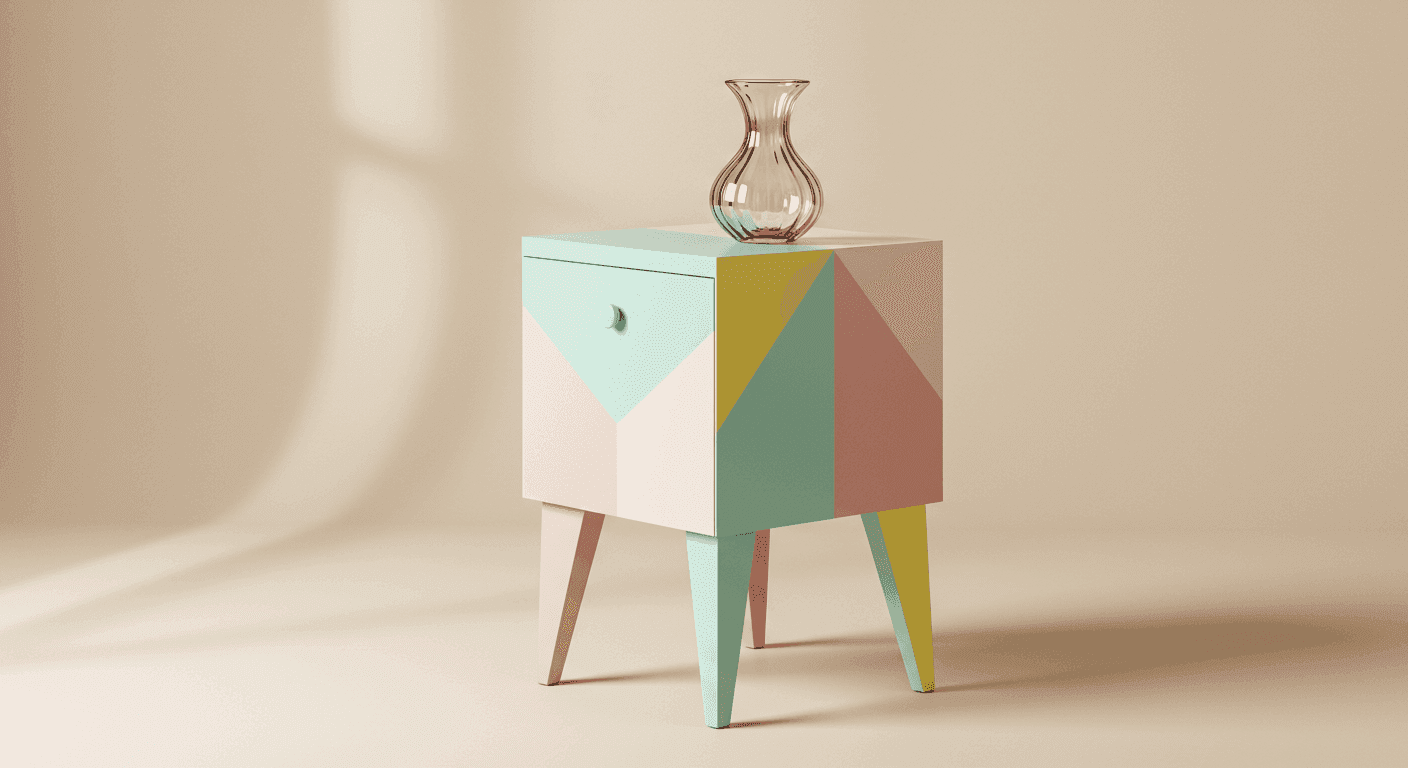
Memphis listings are some of the most polarising pieces our curators handle. They sit on the platform longer on average, but when they sell they often go to international buyers; Portuguese, Belgian and Italian addresses come up disproportionately in Memphis shipments.
A movement that lasted as long as a band's heyday
Memphis ran from 1981 to 1987. Six years, that's it. Ettore Sottsass founded the collective with a small group of younger designers (Michele De Lucchi, Andrea Branzi, Aldo Cibic, Nathalie du Pasquier, George Sowden) and then dissolved it before it could calcify into a brand. That short lifespan is part of why the original pieces are scarce, and also part of what makes the period so interesting.
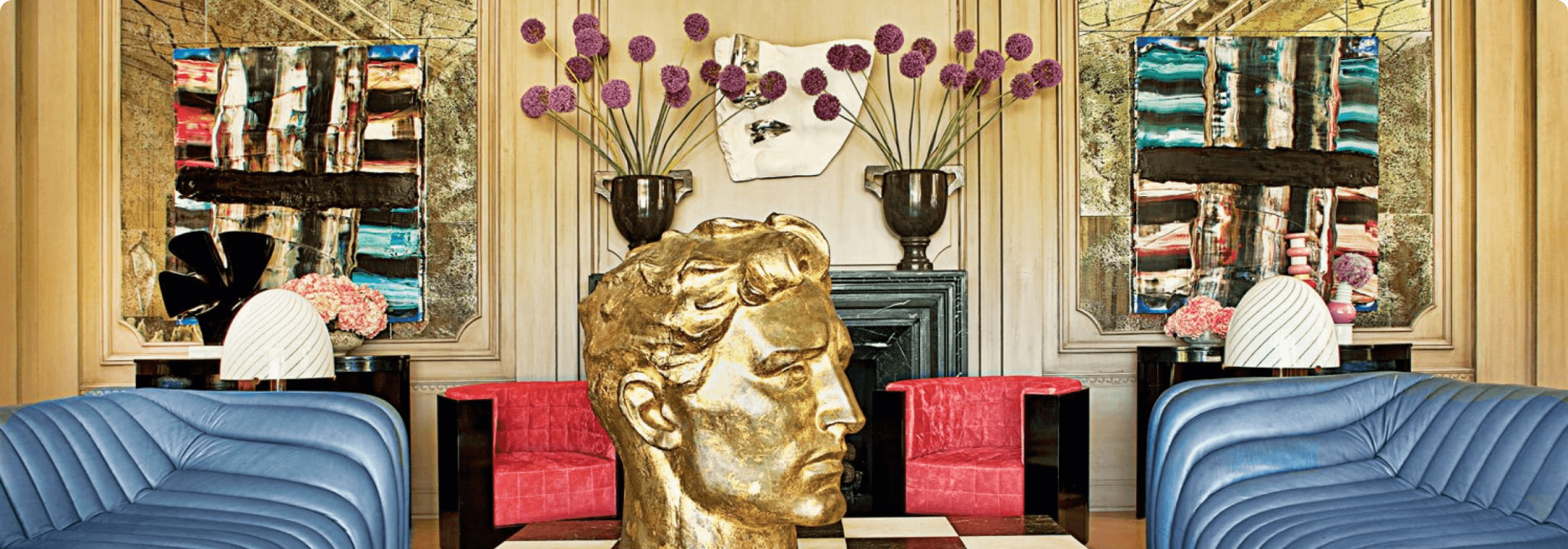
The aesthetic vocabulary is unmistakable. Patterned plastic laminate. Geometric shapes pulled toward absurdity. Colours saturated to a point that would be tasteless if Sottsass weren't so deliberate about every choice. Memphis is the moment design admitted that decoration is allowed, that irony is allowed, and that not everything has to be in white oak. If you grew up with the rule "good design is restrained", Memphis is a holiday from it.
Why it mattered then
In 1981, design discourse was still mostly Bauhaus inheritance: functionalism, "form follows function", reduce until you can't reduce more. Memphis arrived at the Salone del Mobile in Milan and proposed the opposite. Form follows fun. Form quotes Etruscan pottery. Form is patterned to within an inch of its life. The movement scandalised the establishment, and immediately influenced everyone.
You can trace Memphis through every postmodern building of the 1980s, through MTV's title graphics, through Karl Lagerfeld's apartment, through Christian Dior's 1980s couture. The visual language leaked everywhere. That breadth of influence is one reason the secondhand market has aged so well.
What's actually worth buying
Original Memphis production is concentrated in pieces made between 1981 and 1988 by the Memphis Milano company. Look for the Memphis Milano label, usually a paper sticker on the underside or, on later pieces, a small metal plate. Many of the original designs have been re-issued by Memphis Milano under the same brand, which keeps the vocabulary alive but creates a real question of value. An original is more historically interesting. A re-issue is the same object materially. Both are legitimate. Just know which one you're holding.
Ettore Sottsass's Carlton bookcase (1981), the room-divider with bookshelves shooting off at angles in primary colours, is the canonical Memphis object. Originals trade in the €3,500 to €7,000 range right now, with the right provenance pushing higher. Re-issues from Memphis Milano are around €15,000 retail.
Michele De Lucchi's First chair (1983) and Oceanic table lamp (1981) come up regularly. The First chair, with its disc-shaped backrest perched on a steel frame, sells for €700 to €1,500 in original production on Whoppah. Comfortable it is not. Beautiful, in the Memphis sense, it absolutely is.
George Sowden's Acapulco clock (1982), with the dial fragmented across geometric blocks, lists between €450 and €900.
Nathalie du Pasquier designed patterned laminates that you'll spot on Memphis furniture and on the rare original textile. Anything du Pasquier-attributed climbed sharply between 2019 and 2024, and is now stable in the high mid-three-figures.
The 2026 revival
Memphis is having a moment. Three drivers, all reinforcing each other.
A generation of designers who weren't yet born when Memphis closed is referencing it explicitly. India Mahdavi's interiors are the obvious example. Two large auction houses ran well-publicised Memphis-themed sales in 2025, which brought a wave of new collectors into the market. And Camille Walala's commercial work, which is Memphis-adjacent in spirit, has put the patterns back into the cultural mainstream.
Prices on Whoppah for original Memphis pieces have moved roughly 18% up over the past 18 months. Re-issues have moved much less. If you're buying for the object, both are fine. If you're buying with an eye on value, originals are the safer place.
What to be careful about
A lot of "Memphis-style" furniture exists. Bright laminates and chunky geometric forms aren't unique to the movement, and unbranded pieces from 1980s Italian production may be Memphis-adjacent without being Memphis. Whoppah's curation is strict about this. If a listing says Memphis Milano, we want to see the label. If you're ever unsure, ask in the listing chat. The sellers we work with are good about additional photos.
Why I think it'll keep climbing
The pure aesthetic risk-tolerance of Memphis pieces has aged unexpectedly well in a market that's tired of beige. A confident Memphis chair sits in a quiet, neutral room the way a tropical fish sits in clear water. It works precisely because everything around it doesn't. That's a kind of versatility the market didn't recognise in the 1990s, when Memphis was being dumped. Now that we know better, the price is correcting.
If Memphis isn't quite your taste, that's also fine. I'd never push it on someone. But if you've been quietly drawn to it for a few years and haven't acted, the gap between today and a year from now is probably not zero.