Art Deco: what to buy, what to skip, and how to recognise a real Ruhlmann
Art Deco furniture is the most opulent category on the secondhand design market, which makes it the most intimidating to enter. Here's a friendly read on the period, the makers worth chasing, and how to avoid the 1980s revival pieces that often get mislabelled.

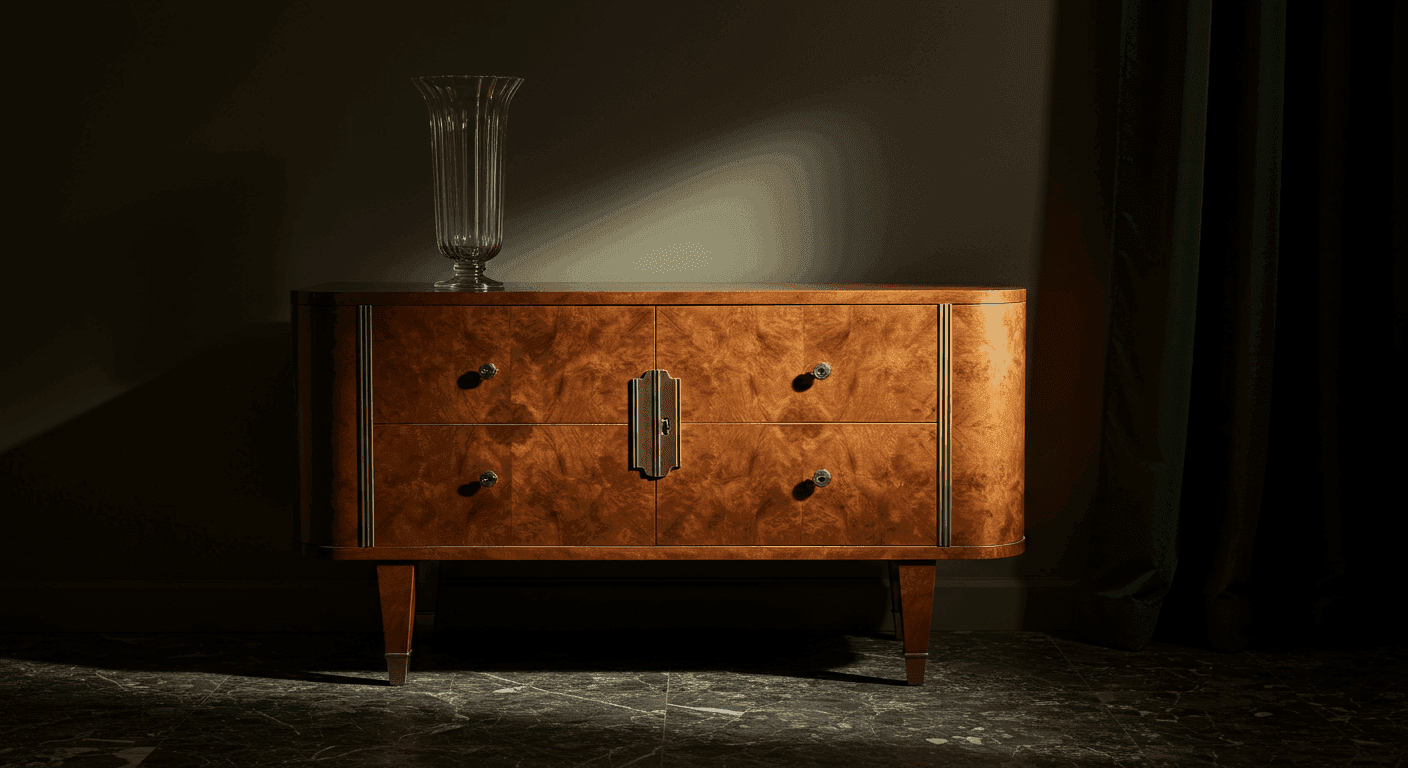
Art Deco runs hot and cold on Whoppah. Our curators have seen Art Deco interest spike around major auction-house sales (Christie's December and Sotheby's spring), then cool again. If you're sourcing, the months immediately after those events tend to be the best window.
What Art Deco actually means
Art Deco peaked between 1920 and 1939. The name itself came retroactively, shortened from the 1925 Paris Exposition Internationale des Arts Décoratifs et Industriels Modernes. It's worth knowing that, because "Art Deco" got applied to so much later furniture that the original boundaries blur.
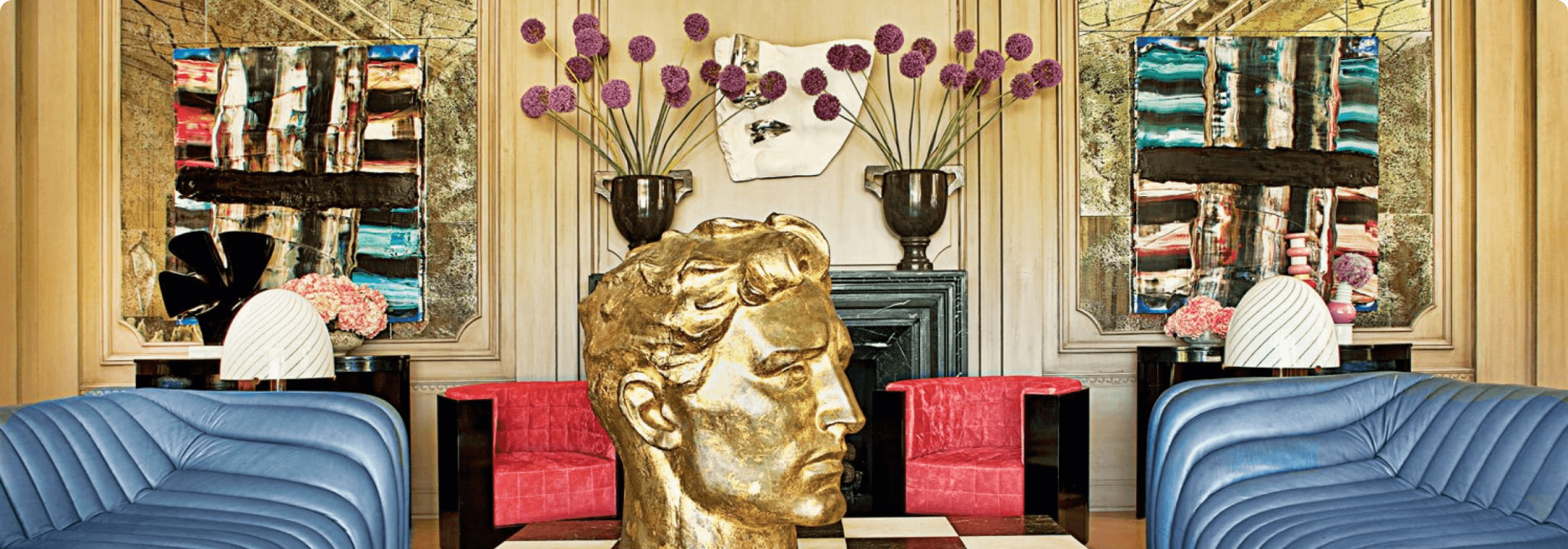
Visually, the period is unmistakable once you've seen a few real pieces. Geometric symmetry. Exotic veneers (Macassar ebony, amboyna, palissander). Inlays of brass and mother-of-pearl. Lacquered surfaces in dramatic black or vermilion. Silver-leafed details. It's the opposite of Art Nouveau's curves. Deco is right angles, stepped pyramids and sunburst motifs.
The movement was Parisian first. The masters were French: Émile-Jacques Ruhlmann, Eugène Printz, Jules Leleu, Jean-Michel Frank. The period after 1929 saw the style democratise through American manufacturers (Donald Deskey, Paul Frankl), into ocean liner interiors, cinemas and the better grade of domestic furniture.
The collectible names
If you're looking at Art Deco on Whoppah, these are the names that matter. I want to give you honest price expectations, not the polished auction-house ranges.
- Émile-Jacques Ruhlmann, the most expensive Art Deco designer at auction. Anything signed by him sits in five-to-six figures, and pieces appear rarely.
- Jean Dunand, lacquer master. His panels and screens are six-figure territory.
- Jules Leleu, more available than Ruhlmann, similarly well-built. Furniture trades €4,000 to €20,000.
- Eugène Printz, sculptural, unusual woods, brass details. €5,000 to €25,000.
- Jean-Michel Frank, minimalist within Deco. His Comfortable Club chair has been re-issued by Ecart International. Originals are €15,000 and up.
- André Sornay, from Lyon, more affordable, structurally clever. €2,500 to €8,000.
- Maxime Old, late Deco, working into the 1950s. €3,000 to €10,000.
Pieces signed by these names tend to come with provenance documentation. Look for the maker's stamp on the underside (Ruhlmann's is a stylised monogram with the workshop number) or original receipts from Galerie Vendôme and the other period galleries.
How to recognise a real Ruhlmann
There are three field tests, and they're worth knowing even if you never plan to buy one, because they'll calibrate your eye for the whole period.
First test: weight. Ruhlmann commissioned the densest possible mahogany and oak substrates, then veneered them in Macassar ebony. A Ruhlmann small commode weighs roughly twice what its size suggests. Counterfeits use lighter substrates and feel hollow when you tilt them.
Second test: inlay quality. Ruhlmann's ivory inlays (mostly elephant ivory before the trade was restricted, some workshops moved to mammoth ivory later) are fitted to a hair's-width tolerance. Look at the corners. If you can see the inlay shifting in its channel, even slightly, it's not him. Originals don't shift, ever.
Third test: the underside. Ruhlmann's workshop branded its production with a hot-iron stamp showing his interlocked initials, the workshop number, and often the year of production. The stamp sits in a specific location depending on the model. There's a published catalogue raisonné (Florence Camard's Ruhlmann) that buyers serious enough about the category should own.
Two big risks in this market
I want to flag the things I see go wrong most often, because they're easier to avoid once you know.
The first is the 1980s revival. Postmodernism in the 1980s produced enormous quantities of Deco-styled furniture: chunky, lacquered, often in MDF substrates with thin veneer. These pieces have their own modest charm, and I'm not against them. But they shouldn't be confused with period 1920s work, and they sometimes are on open marketplaces. Whoppah's curation differentiates clearly. If you're shopping elsewhere, ask the seller about substrate weight and veneer thickness, in plain English. An honest seller will know.
The second is over-restoration. Period Art Deco often has finish damage from a century of polish, humidity and use. Tasteful restoration is fine. Removing the original finish entirely and refinishing in modern lacquer destroys value, because what made the piece interesting was the original lacquer's depth. If a listed Ruhlmann or Leleu looks brand new, ask why. There's usually an honest answer, but it's worth confirming.
What's reasonably available
If you'd like to live with the period without the Ruhlmann budget, here's where I'd point you. Sornay pieces. Anonymous French Deco sideboards in palissander. Italian Deco from makers like Vittorio Dassi or Paolo Buffa. The €1,500 to €4,500 band on Whoppah contains real Art Deco furniture from real Paris (or Italian) workshops. Just not the famous-name workshops. Those pieces are excellent, and you don't pay the Ruhlmann premium.
Why the prices won't soften
Art Deco was the last period when European cabinetry was made to museum standard for domestic clients. The combination of materials, hand work and design ambition is not replicable today. The labour costs alone would put a 1925 Ruhlmann commode well past €100,000 if you tried to commission a new one. That's the structural reason Deco prices stay where they are.
If you can stretch to a small piece (a side table, a chair, a mirror), it'll outlast every other piece of furniture you own. And it'll quietly anchor a room in a way newer pieces struggle to. That's the framing that helps me when I'm advising friends. It might help you too.