Scandinavian Modern: why Danish chairs still set the standard sixty years on
Three decades of Danish furniture production set the template for what design-conscious living looks like in 2026. Here's a friendly tour of the makers, the pieces, and the secondhand market that lets you actually live with them.

Scandinavian Modern is the category I see myself buying from most. Of the 16 markets we ship to, the Nordic-design fluency runs deepest in the Netherlands, Belgium and Germany, but I'm seeing Spanish and Italian buyers move into Wegner and Juhl more aggressively each quarter.
Why specifically Danish
Scandinavian Modern covers Denmark, Sweden, Finland and Norway from roughly 1940 to 1975. All four countries contributed, and beautifully. But the dominant chapter, the one that travelled, the one the rest of the world copied, the one that still defines the look, was Danish.
The Danish furniture industry of the post-war period had three things in unusual alignment. World-class designers (Hans Wegner, Arne Jacobsen, Finn Juhl, Børge Mogensen, Verner Panton, Poul Kjærholm). World-class joinery training, anchored by the Copenhagen Cabinetmakers' Guild's annual exhibition, which pushed everyone harder than they would have pushed themselves. And a small domestic market that forced every maker to export. The result was extremely well-made furniture priced to compete globally, and a generation of designers who became household names because their work was actually in houses.
Sixty years later, the same pieces are still being made, still being collected, and (this is the part that matters for you and me) still affordable on the secondhand market relative to their re-issues.
Hans Wegner: the chair maker
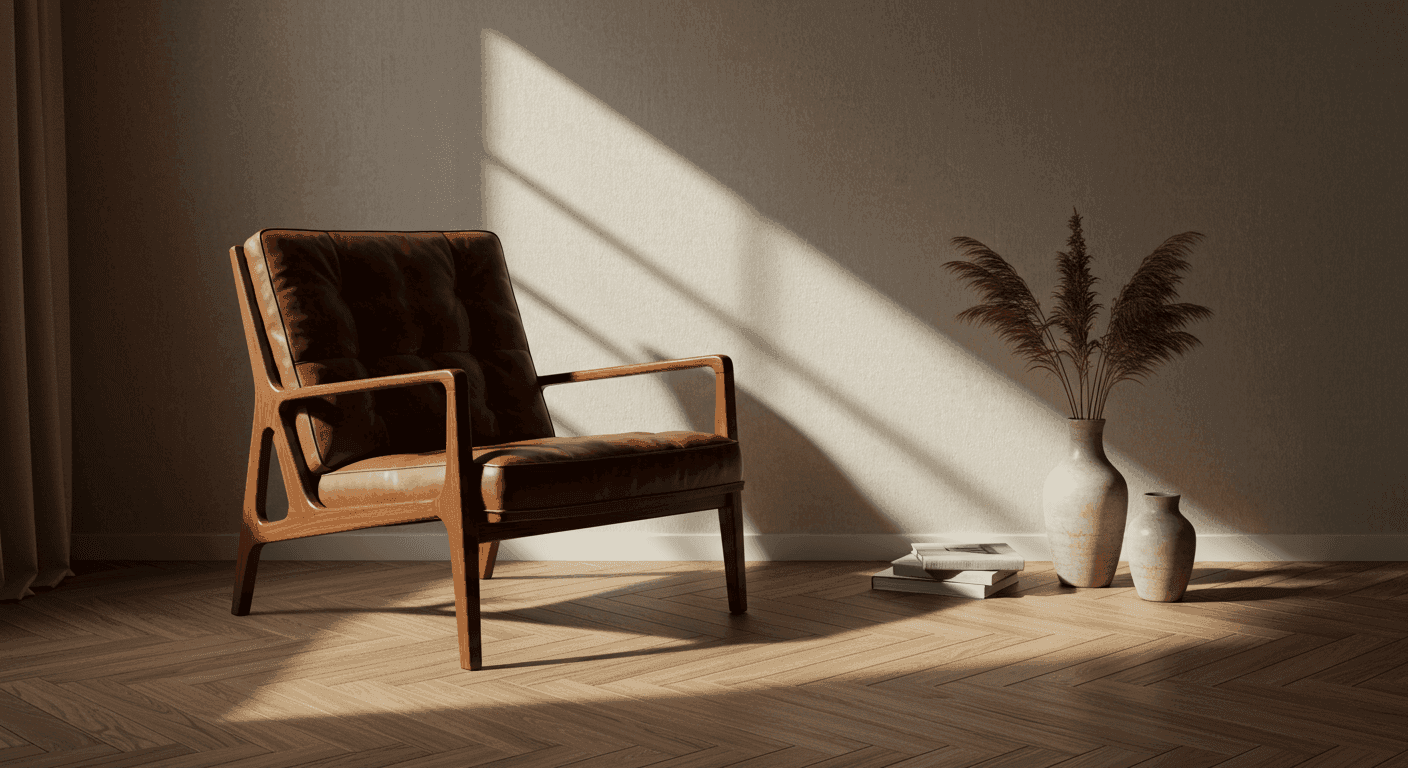
Wegner designed about 500 chairs in his career. Let me give you the four you'll see most often on Whoppah, with honest price guidance.
- CH24 Wishbone (1949), paper-cord seat, distinctive Y-shaped backrest. In continuous Carl Hansen & Son production since 1950. Original 1960s examples sell for €500 to €1,000 on Whoppah.
- CH25 Lounge (1950), woven paper-cord on a low oak frame. €1,200 to €2,500 in original production.
- GE 290 (1953), wing-back lounge chair with a separate ottoman. Made by Getama, harder to find than the Carl Hansen pieces. €1,800 to €4,500.
- PP503 The Chair (1949), the chair John F. Kennedy used at the 1960 presidential debate. Original PP Møbler production sits at €4,000 to €8,000.
How to authenticate. Every Wegner has a maker's plate. Carl Hansen pieces carry a metal disc on the underside of the seat or frame. PP Møbler pieces are stamped directly into the wood. Replacement seats (paper cord or leather) are accepted and very normal on a 60 year old chair, as long as the frame is original.
Arne Jacobsen and the architectural chairs
Jacobsen designed for the Royal Hotel in Copenhagen and the SAS Royal Hotel. The chairs that came out of those commissions became some of the most recognisable shapes in design history.
- Egg (1958), the iconic egg-shaped lounge chair. Fritz Hansen production. €3,500 to €7,000 in good vintage condition.
- Swan (1958), the smaller companion to the Egg. €1,800 to €3,800.
- Series 7 (1955), the moulded plywood stacking chair Christine Keeler posed on for Lewis Morley. €250 to €500 each.
- Ant (1952), three-legged plywood chair. €350 to €700.
Every authentic Jacobsen piece is made by Fritz Hansen. If you see one attributed to Jacobsen from any other manufacturer, it's either a licensed earlier producer (rare) or a knock-off.
Finn Juhl: the painter who happened to be an architect
Juhl's chairs look like sculpture and feel like upholstery. His early work was made by Niels Vodder. Later pieces went to Bovirke and to House of Finn Juhl. The visual signature is the way Juhl separated the seat from the frame so they seem to float, and his use of teak with leather inlay strips.
- Chieftain (1949), the lounge chair with the carved teak frame and dramatically angled backrest. €5,000 to €12,000 in original Vodder production.
- 45 chair (1945), earlier than the Chieftain and arguably more elegant. €3,000 to €7,000.
- Pelican (1940), the round-shouldered easy chair. €4,500 to €9,000.
Juhl prices are higher than the rest of mid-century Danish, because the original Vodder production runs were small. If your budget doesn't stretch there yet, I'd say wait. Don't buy a re-edition just to have the name. The originals will keep coming up.
Børge Mogensen and the J39
Mogensen aimed at something Wegner mostly wasn't interested in: democratic, affordable furniture. The J39, the Shaker-influenced "people's chair", is the result. It costs €120 to €280 on Whoppah and is structurally the best value in mid-century Danish furniture. Please don't overlook it just because the famous designers cost more. A J39 in your kitchen will outlast everything around it.
What to look for on Whoppah
Provenance, signature stamps, original upholstery (or transparent disclosure when it's been redone). The red flags to watch for: refinished frames that have lost their original colour, replaced seat shells, teak veneer over MDF instead of solid teak. Our curation team flags these before listings go live, but it doesn't hurt to know how to spot them yourself.
The market for Danish modern has been stable for fifteen years. That stability means buying isn't a speculative upside bet. It's a quality decision. The piece you bring home will hold its value because Danes already paid attention to making it last. That's a comforting position to buy from.