Marcel Breuer: the student who bent the chair forward by fifty years
Marcel Breuer designed the Wassily chair while still a student at the Bauhaus. The cantilever Cesca came three years later. Two single chairs, two revolutions in furniture, both still in production a century on.

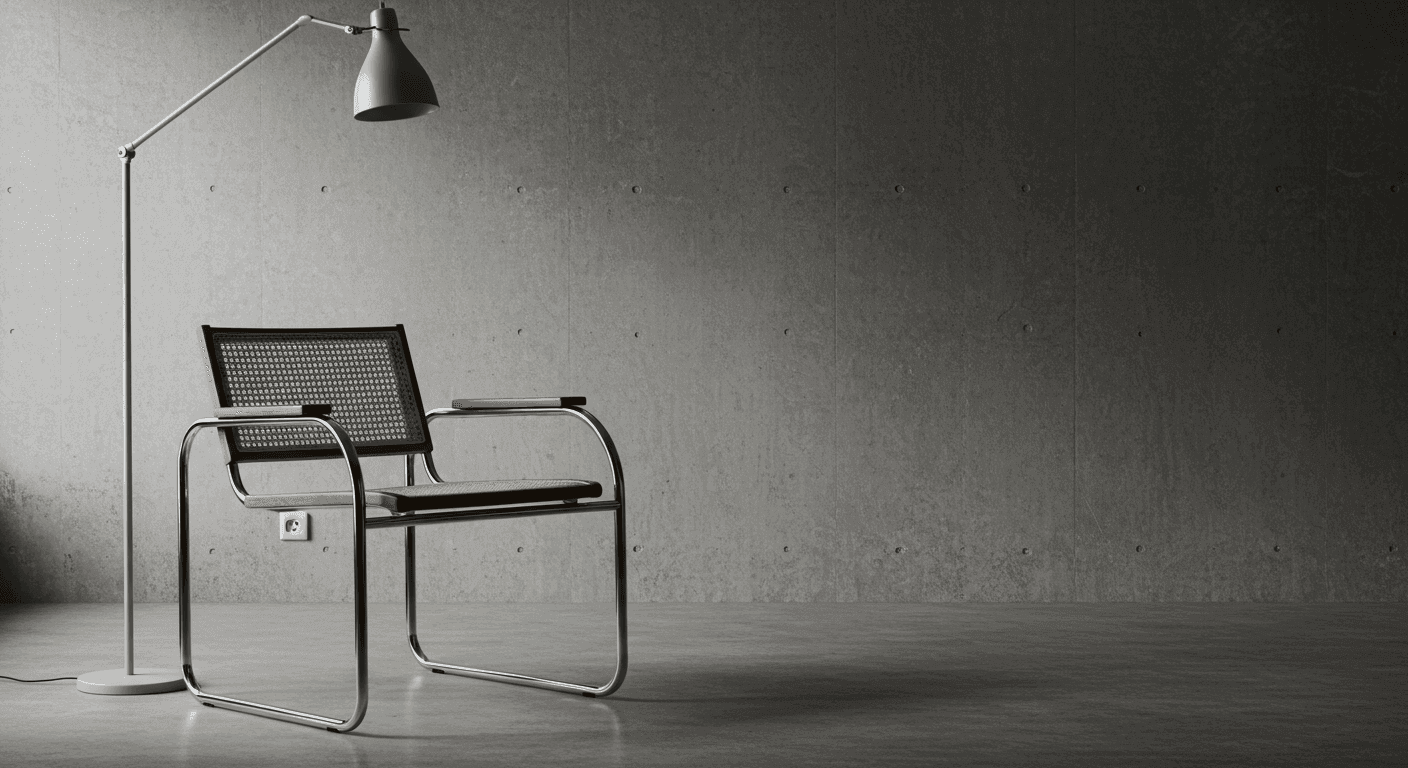
Breuer's Wassily and Cesca chairs are some of the most-replicated designs in furniture history, which means our curators spend real time authenticating them. The good news is that the original Thonet and Knoll markings are unambiguous when present.
A young Hungarian at the Bauhaus
Marcel Breuer (1902 to 1981) was 23 years old when he designed the Wassily chair in 1925. He was a student at the Bauhaus in Dessau at the time, in the carpentry workshop, and he had recently been impressed by the bent tubular steel of his bicycle's handlebars. He bent steel into a chair frame the same year. That's how the story goes, and the chair itself doesn't disprove it.
I find Breuer particularly easy to like because his pieces are so direct. The Wassily is what happens when you ask a 23-year-old to solve "make a chair out of this new material I'm holding". The Cesca is what happens three years later when the same person has learned to refine.
He left Germany when the Bauhaus closed under Nazi pressure in 1933, taught at Harvard, and went on to a major architectural career (the Whitney Museum's old building, UNESCO headquarters in Paris). But the chairs are still what people remember.
What he made
The Wassily B3 (1925), with its tubular steel frame and leather sling seat and back, was renamed after Wassily Kandinsky, who got one of the early examples for his Bauhaus apartment. Knoll has produced it since 1968. Vintage Knoll Wassilys from the 1970s and 80s, with the original cognac, black or white leather, sit at €700 to €1,400 on Whoppah.
The Cesca B32 (1928), the cantilever side chair with caned seat and back on a chromed steel frame, is the most-produced chair design of the 20th century. Knoll holds the licence. Authentic vintage Knoll Cescas sit at €200 to €500 each. Some of the most affordable real Bauhaus you can buy.
The Cesca B64 (1928) is the armchair variant: same cantilever, with arms. €350 to €700.
The Laccio side and coffee tables (1925) round out the set. Around €400 to €900 used.
Why these chairs are worth buying in 2026
The cantilever was a structural revolution. Until Breuer (and roughly simultaneously, Mart Stam), every chair had four legs because everyone assumed you needed four legs. The cantilever proved you didn't. That structural lightness translates into furniture that takes up less visual space in a room, which is one of the most underrated qualities you can have.
Cane seats wear over twenty to thirty years and need re-caning. This is normal, reasonably priced, and not a value-killer. Original chrome should be clean and even; pitting is harder to repair.
How to spot a real Knoll
Sewn leather hide label inside the seat panel reading KNOLL INTERNATIONAL. Metal serial-number plate on the underside. Single continuous bent steel tube (no welded joints visible). Italian and German copies are everywhere and aren't the same object. A genuine vintage Knoll Wassily for €900 is a better object than a brand-new copy for €450.