Kartell: the Italian brand that turned plastic into furniture's serious material
Kartell has been making plastic furniture in Milan since 1949. They produced Joe Colombo's earliest plastic chairs, Philippe Starck's Louis Ghost, and most of the iconic Italian plastic catalogue of the past 50 years. Here's the short story.

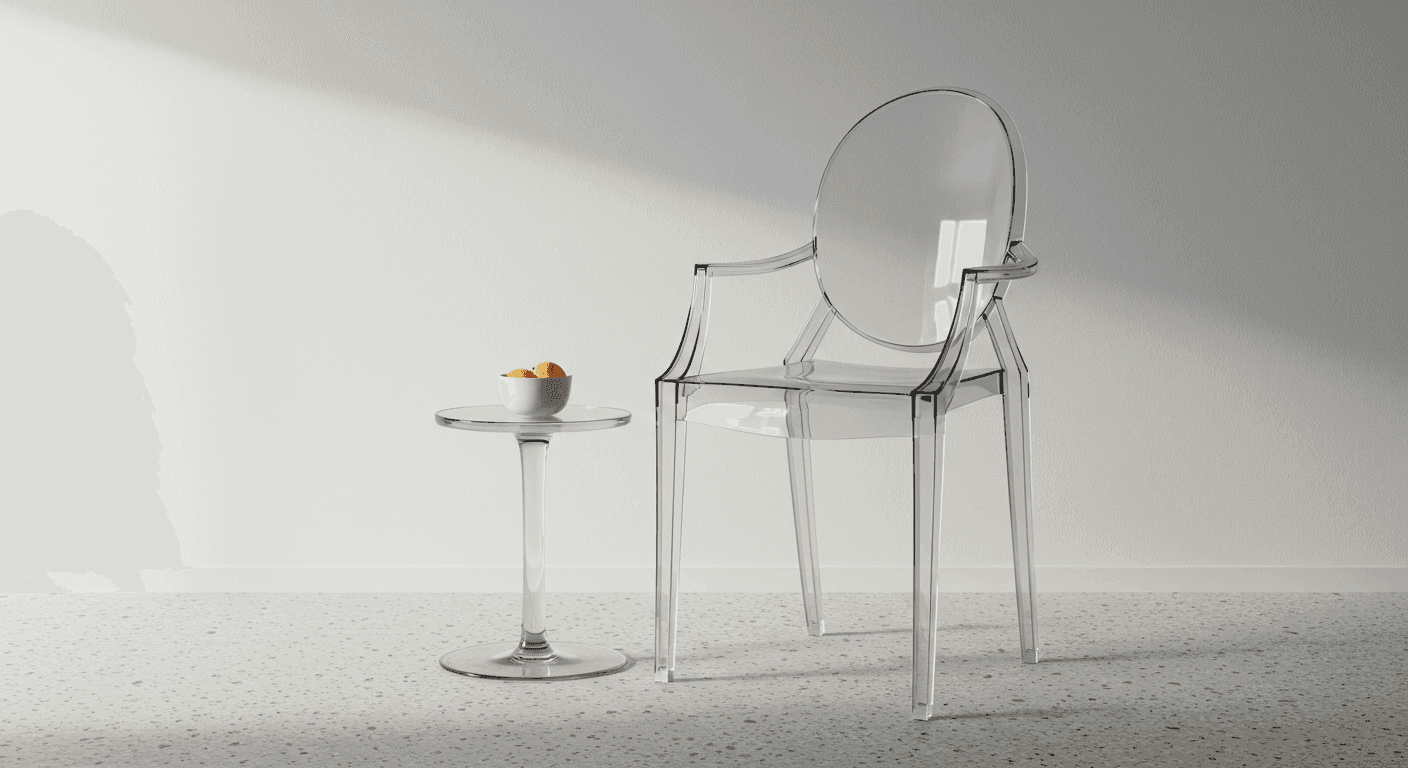
Kartell listings span the full Starck, Citterio and Lissoni range. Our curators check piece condition closely because Kartell's polycarbonate ages distinctively; clean pieces hold value, scratched pieces drop sharply.
Kartell was founded in 1949 in Noviglio, just outside Milan, by Giulio Castelli, a chemical engineer. The founding brief was specific: produce industrial plastic objects (originally car accessories, lab equipment, household items) at quality levels comparable to traditional materials. The shift toward furniture came in the 1960s, when Kartell commissioned Joe Colombo's 4860 chair (1965), the first single-piece moulded ABS plastic chair in industrial production. The 4860 predated the Vitra Panton chair's production by two years.
The Kartell catalogue since the 1960s reads like a curriculum of Italian and international design: Joe Colombo (the 4860 and 4867 Universale stacking chairs), Anna Castelli Ferrieri (the Componibili modular storage tower, 1969), Philippe Starck (the Louis Ghost chair, 2002; the Bourgie lamp, 2004), Antonio Citterio, Patricia Urquiola, Ferruccio Laviani, and the Bouroullec brothers.
The Componibili (1969), the cylindrical modular plastic storage tower in white, black or saturated colours, is the Kartell piece with the largest household population. Vintage examples from the 1970s and 80s sell on Whoppah at €60 to €180 per module.
The Louis Ghost chair (Philippe Starck, 2002), the transparent polycarbonate Louis XV-style chair, is the brand's contemporary bestseller. Authentic vintage Louis Ghosts run €120 to €280 each.
The Universale 4867 (Joe Colombo, 1968), one of the world's first injection-moulded thermoplastic stacking chairs, sells at €250 to €650 in vintage production.
What to look for on the secondhand market: every authentic Kartell piece carries a moulded Kartell logo on the underside or back of the seat. Vintage 1960s and 70s production should show plastic patina (slight colour shift, micro-scratches); pristine "new-looking" pieces are often modern reissues or copies.
The Louis Ghost is heavily copied. Real Kartell production uses a specific polycarbonate quality with a recognisable optical clarity. Cheap copies have a slightly milky cast and crack at the joints faster.