Joe Colombo: the Italian futurist who designed for a world that arrived later
Joe Colombo designed for the year 2000 from his Milan studio in the 1960s. He died at 41 and left a catalogue of plastic, modular, sci-fi furniture that became the visual reference for everything we now call 'Space Age'.

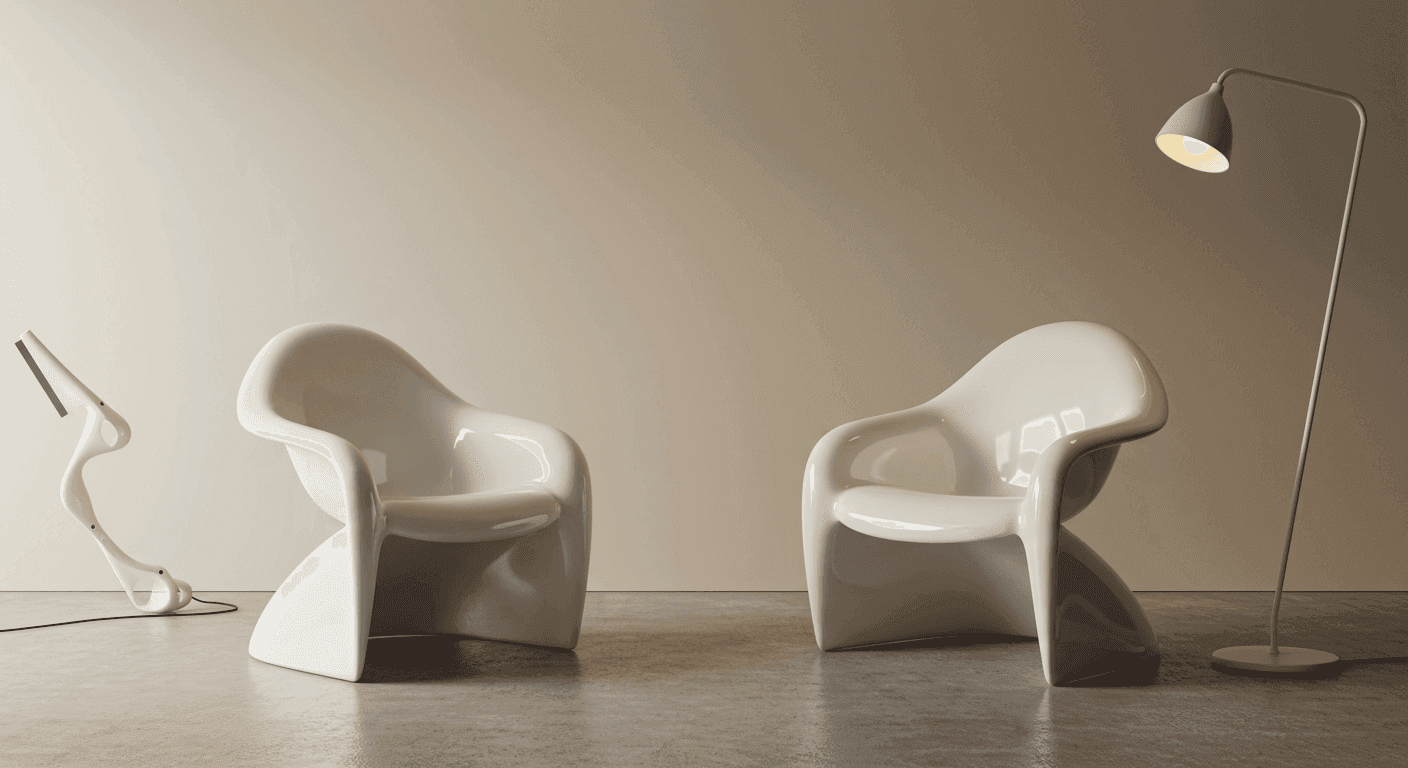
Joe Colombo (1930 to 1971) died of a heart attack on his 41st birthday, and in the 16 years he was designing he produced most of what we now call Space Age furniture. His 4860 chair for Kartell (1965) was the first single-piece moulded ABS plastic chair in industrial production, two years ahead of the Panton chair. On Whoppah a vintage 4860 sells at €350 to €800, the Universale 4867 at €250 to €650, and a 1970s Boby trolley at €350 to €900 against roughly €450 for current B-Line production. Colombo has a small but loyal collector following here, mostly Italian and French sellers selling to buyers in the same markets.
A career cut short, but vivid
Joe Colombo (1930 to 1971) died of a heart attack on his 41st birthday. In the 16 years he was professionally designing (he started his independent studio in 1962), he produced one of the most concentrated and influential catalogues of mid-century Italian design. Everything you think of as "Space Age furniture" (white-on-white, plastic, modular, futurist) traces back substantially to him.
I find Colombo particularly poignant because the future he was designing for arrived after he was gone, and arrived differently from how he imagined. He thought we'd be living in compact units with multifunctional integrated furniture. He was right about the compact units (urban apartments) but wrong about the integration (we mostly still have separate chairs and tables). His furniture survives because it works as separate pieces too, even though that wasn't the original brief.
The pieces
The 4860 chair (1965, for Kartell), the first single-piece moulded ABS plastic chair in industrial production, is the technical-history piece. It predated the Vitra Panton chair's production by two years. Vintage Kartell 4860s from the 1960s in saturated colours sell for €350 to €800 on Whoppah.
The Universale 4867 chair (1968, for Kartell), the cleaner, more refined successor, runs €250 to €650 used. The Kartell archive lists it as the world's first injection-moulded thermoplastic stacking chair.
The Boby trolley (1970, for Bieffeplast, later B-Line), the wheeled storage unit with rotating shelves and drawers, is the perennial favourite. Vintage examples from the 1970s sit at €350 to €900 on Whoppah; current B-Line production retail is around €450. A genuine 1970s Boby in original colours is the better object.
The Tube chair (1969, for Flexform), four foam cylinders that slot together into a chair, is the most conceptually playful piece. €1,500 to €4,000 in good vintage condition.
The Spider lamp (1965, for Oluce) is the iconic table lamp with the articulated arm and conical reflector. €700 to €1,800 used.
Why are Joe Colombo prices so stable?
Colombo prices have been steady rather than rocket-like for the last decade. Part of this is that the Space Age aesthetic has been in and out of fashion. Part of it is that the plastic materials (especially saturated colours from the 1960s and 70s) yellow and craze over time, so condition assessment matters more than for wood pieces.
That stability is actually a buyer's advantage. You're not chasing a market here. You're choosing a piece you want to live with, at a price that hasn't been speculatively inflated.
How do you authenticate a Joe Colombo piece?
Kartell-produced Colombos carry a moulded Kartell logo somewhere on the underside or back of the seat. Bieffeplast/B-Line Bobys have a paper label on the base. Oluce lamps have the Oluce mark on the base. Vintage 1960s and 70s production should show some plastic patina (slight colour shift, micro-scratches); pristine "new-looking" pieces are often modern reissues or copies.