Achille Castiglioni: the engineer who designed lamps that don't look like lamps
Achille Castiglioni and his brother Pier Giacomo defined what we think of as Italian post-war lighting. Their pieces start from a structural problem and arrive at a beautiful object. Here's the short field guide.

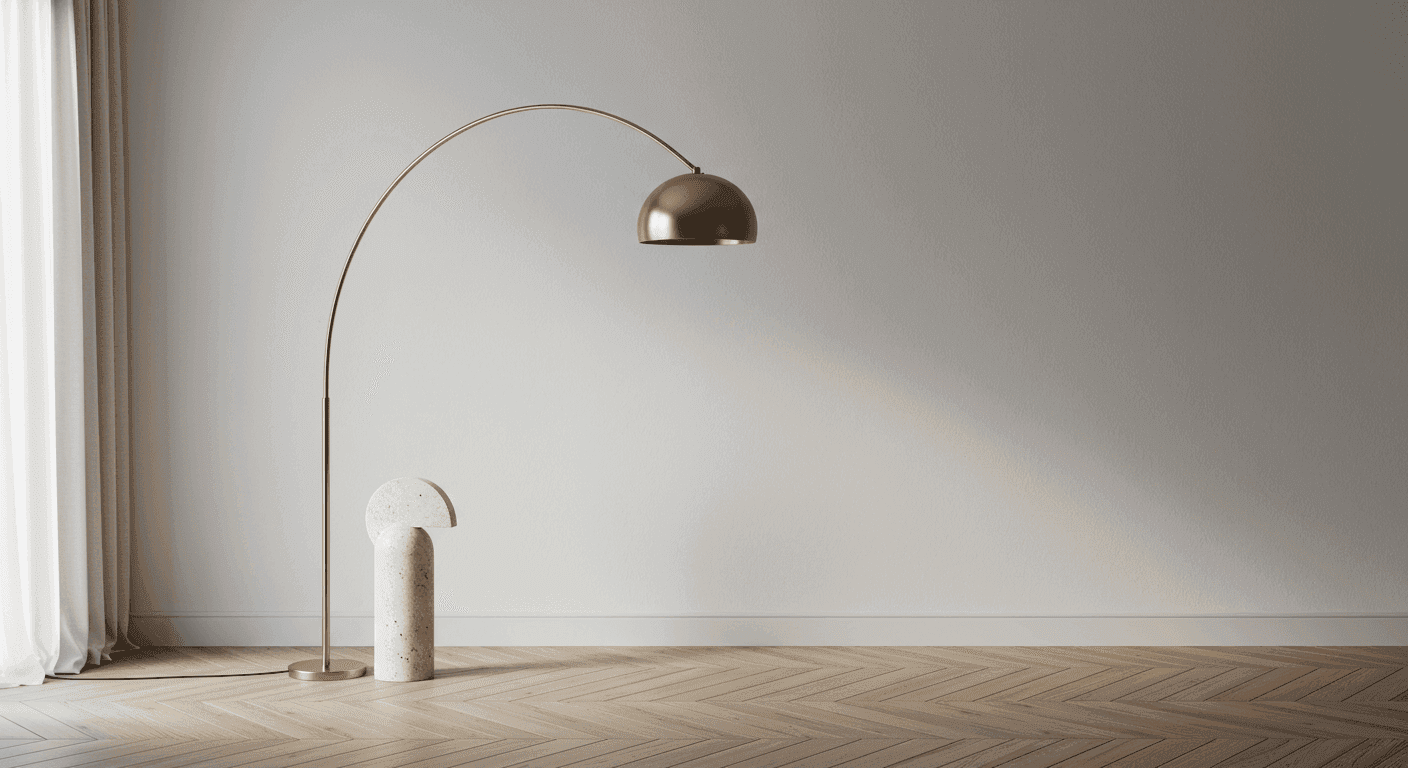
Castiglioni pieces, especially the Arco and Snoopy lamps, are some of the most-asked-about by our buyers. Our curators verify the Flos production markings carefully; unmarked pieces require provenance.
Two brothers, one practice
Achille Castiglioni (1918 to 2002) worked with his older brother Pier Giacomo (1913 to 1968) from 1944 until Pier Giacomo's death. They had a third brother, Livio, who was also a designer, mostly for Phonola radios. The Castiglioni practice in post-war Milan was the engine of Italian industrial design alongside Ponti's Domus.
I find Achille particularly easy to admire because his work is so structurally honest. The Arco floor lamp (1962) is shaped like an arc because that's the shape that lets the light hang centrally over a dining table without putting a fixture in the ceiling. The Mezzaluna door handle (1955) is shaped the way it is because that's the shape that fits a thumb closing a door. He started from problems, not from images.
The lamps that defined a category
The Arco floor lamp (1962, with Pier Giacomo, made by Flos) is the icon. A polished stainless arched arm extending 2 metres from a 65kg block of Carrara marble. The marble has a hole in it for a broomstick to be threaded through, so two people can lift the lamp at a piece of broomstick. That detail is pure Castiglioni: thoughtful, structural, slightly wry. Authentic Flos Arcos from the 1970s and 80s sit at €2,000 to €4,500 on Whoppah; current Flos retail is around €3,200.
The Snoopy table lamp (1967, with Pier Giacomo, Flos), with a Carrara marble base and a black lacquered metal shade reminiscent of the cartoon dog's head, runs €800 to €2,200 in good vintage condition.
The Tubino table lamp (1951, with Pier Giacomo) is the under-appreciated piece. Slim chromed tube on a counter-weighted base. €350 to €700 used.
The Toio floor lamp (1962), made from off-the-shelf parts including an actual car headlight bulb and a fishing-rod mount, is the most conceptually playful. €700 to €1,500.
Why his work holds up
Castiglioni lamps don't date because they weren't designed to be of a moment. They were designed to solve a specific lighting problem, and lighting problems don't change much. An Arco in a 1965 living room and an Arco in a 2026 living room do exactly the same job, equally well.
Authentication
All authentic Castiglioni lighting for Flos carries Flos branding. On the Arco, look at the underside of the marble base: the Flos label and a model identifier are there. On Snoopy and Toio, the branding is on the metal components.
Be careful with Italian copies of the Arco. They're abundant, often quite convincing in photos, and the giveaways are the marble (real Arco marble is Carrara with specific veining; copies often use stained granite or composite stone), the arc steel quality (Flos uses polished stainless; copies often use chrome-plated mild steel that pits), and the broomstick hole (always present on real Arcos, often skipped on copies).