Have it delivered hassle-freeBuyer protectionAll Designer items curated by WhoppahDownload the Whoppah App – get alerts & sell with ease.
Have it delivered hassle-free
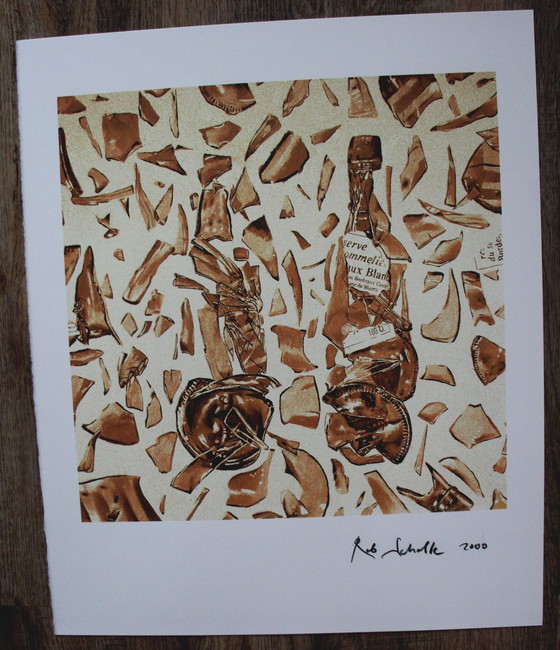
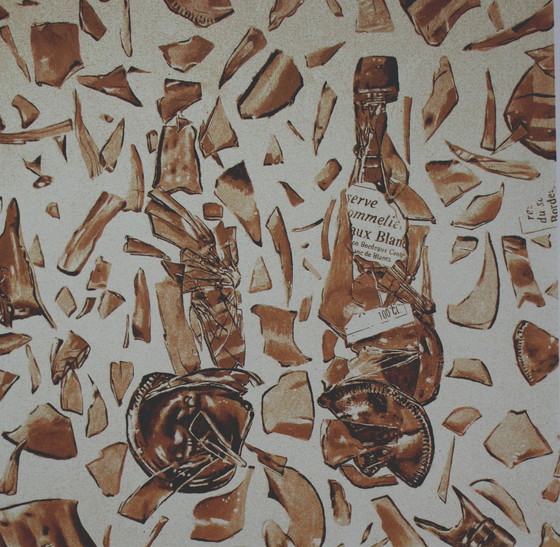
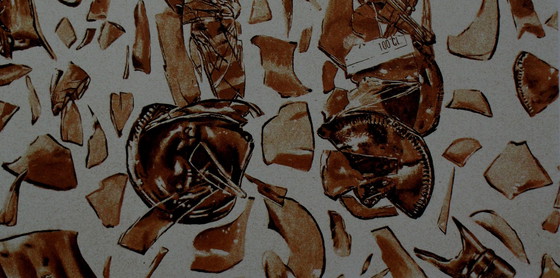
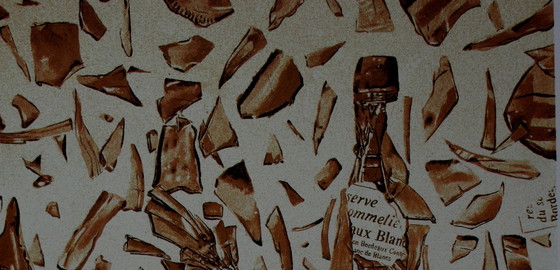
Rob Scholte -Mis en Bouteille dans nos Caves
€175
Buy with confidence
Shop & pay safely with Buyer ProtectionDesigner items curated by WhoppahWe only pay the seller once you have safely received the itemTrusted payment methods


About this seller
Professional's-Gravenzande, NetherlandsOn Whoppah since March 2022 • 34 sales
Product description
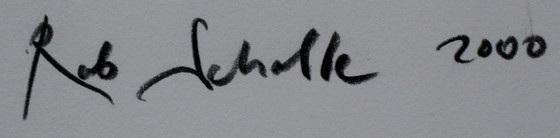
Screen print by Rob Scholte. Title: Mis en Bouteille dans nos Caves. Year: 2000. Sheet dimensions: H63 x W52cm. Image dimensions: H44 x W44cm. The work is signed by the artist at the bottom right. The authenticity of this work is fully guaranteed. A certificate of authenticity is included.
Shipping/Pickup: Upon purchase, the work can be picked up in 's-Gravenzande (near The Hague (Scheveningen), Rotterdam, and Delft, and 5 minutes from the beach). The pickup period, upon prepayment, is very generous; in other words, the buyer can pick up the work weeks or even months later and, if possible, combine it with a visit to one of the aforementioned cities or the beach. The work can also be shipped via Postnl. Our shipping days are Tuesday and Thursday.
Robert Egbert Gerardus (Rob) Scholte (Amsterdam, June 1, 1958) is a Dutch artist. Life and work until 1994
In his youth, Scholte lived in Castricum, Doorn, Heiloo, and Egmond aan den Hoef. At the age of 17, he left his parental home through the attic window. From 1977 to 1982, he studied at the Gerrit Rietveld Academy. Afterwards, he was part of the artist collective W139, among others, where he debuted with Sandra Derks in 1982 with the 'masterpiece' Rom 87 (now in the collection of the Cultural Heritage Agency of the Netherlands, on loan to Museum Boijmans Van Beuningen), a series of variations painted in a free style on a book of children's coloring pages. He would replace this style with meticulously painted works, which he began exhibiting in 1984 in the newly established gallery The Living Room in Amsterdam. In 1986, he caused a stir with the painting Utopia (Museum Boijmans Van Beuningen), in which Manet's Olympia was quoted. However, he had replaced Olympia and her maid with wooden dolls. It turned out that he had not invented this idea himself, but had borrowed it from an obscure postcard found by chance. Scholte responded by repainting the newspaper article in which he was accused of plagiarism, a literal quote of half a newspaper page.[2] With How to Star, a solo exhibition at Boijmans Van Beuningen featuring paintings from 1983-1988, Scholte received both praise and criticism. Works by Scholte were shown at documenta in 1987, and in 1990 he was commissioned to design the Dutch pavilion at the Venice Biennale. In 1991, he met Micky Hoogendijk, with whom he began a relationship. He made her director of his private limited company, and on May 31, 1994, they married at the house temple the RoXY. Also in 1991, Rob Scholte BV secured the commission for a 1,200-square-meter wall and ceiling mural at the Huis Ten Bosch Resort in Nagasaki, Japan. Scholte worked with a large number of assistants on the painting, titled *Après nous le déluge*, about the continuous recurrence of war in history. Its opening was scheduled to take place on August 9, 1995, coinciding with the 50th anniversary of the atomic bomb on Nagasaki, but had to be postponed due to an attack on Scholte. From 1993 to 1999, Scholte was a lecturer at the Kassel Academy of Fine Arts. Bombing On November 24, 1994, Scholte and Hoogendijk got into his dark blue BMW 525i at Laurierstraat in Amsterdam. Shortly after he had driven away, a hand grenade exploded under the car. Scholte was seriously injured. Both his legs had to be amputated above the knee. Hoogendijk, who was pregnant with Scholte's child, suffered a miscarriage. The perpetrator of the attack was never found. One of the theories was that the attack was intended for the lawyer Oscar Hammerstein, but that the perpetrator had mistaken the car. Hammerstein drove a similar type of BMW, of the same color, and with almost the same license plate, which was parked nearby. Scholte himself initially accused a fellow artist, the fringe photographer Paul Blanca. Later, the poet Koos Dalstra was blamed. Dalstra initiated a defamation lawsuit against Scholte and won it all the way to the Supreme Court. Other theories relate to the shady milieu of artists, cocaine dealers, and money laundering practices in which Scholte allegedly moved at the time (described by Joost Zwagerman in his novel Gimmick!) and boil down to the idea that the attack was a punishment for gambling debts, cocaine debts, or unfulfilled obligations. In 2019, Scholte stated in an interview that he knew who the perpetrators were. In early February 1995, Scholte founded a Committee of Vigilance, modeled after the Committee of Vigilance that Menno ter Braak and E. du Perron founded in the 1930s against the rising National Socialism. The idea had been suggested to Scholte by Felix Rottenberg. This committee was intended to become a political movement, but the initiative died a quiet death. Scholte left for Japan again that same year to complete the mural Après nous le déluge. He subsequently moved to Tenerife. Hoogendijk and Scholte parted ways in 1997. Scholte later remarried and has been living in the Netherlands again with his wife and two children since 2003. In 2021, he was living with his mother, back in the room he ran away from when he was 17. He is still together with his wife. Rob Scholte Museum, Den Helder Rob Scholte Museum just before closure, 2018 In 2013, a museum dedicated to him was opened with limited resources in the former Main Post Office in Den Helder, a design by architect Jo Kruger from 1967. The museum was initially considered an asset to Den Helder,[5] but after a few years the municipality reclaimed the building in order to sell it. In October 2017, the judge ruled in summary proceedings that the museum could continue to exist for the time being. However, in April 2018, following a ruling on appeal, the museum was vacated. Subsequently, in September 2018, the Alkmaar District Court ruled in a main proceedings that Scholte did not have the building on loan, but had a lease agreement with the municipality. That could imply that the eviction had been unlawful. However, a year later, on September 18, 2019, the Alkmaar court ruled that the municipality had acted lawfully, that Scholte held a usage agreement rather than a lease agreement, and was therefore indebted to the municipality for a sum of several hundred thousand euros for eviction and storage costs, as well as gas, water, and electricity. The municipality seized Scholte's collection to have it auctioned. A judge in summary proceedings prevented this. Ultimately, the collection was allowed to be auctioned after all. Working method Scholte is an image maker. He organizes and places images—from the mass media, from his own extensive archive—in a new context, thereby imbuing those images with new meaning. Often, one finds contradictions and oppositions in his works that are 'overcome' in their new context. The meticulously painted works by his hand are usually produced by assistants and signed by himself. In doing so, he follows a 17th-century method of working. His working method is illustrative of postmodernism and emphasizes the permanent influx of images that surround, shape, and mold us. The media are always thematic; he draws inspiration from them, criticizes their manipulation, and has also acted as a 'media personality' himself.
The background color is in reality a bit more beige, this does not come across very well in the photo.
The background color is in reality a bit more beige, this does not come across very well in the photo.
Specifications
ConditionVery goodColorsBeige, BrownNumber of items1StyleAbstractArtistsRob ScholteSubjectAbstractHeight52 cmWidth63 cm
Seller information
About this seller
Professional's-Gravenzande, NetherlandsOn Whoppah since March 2022 • 34 sales