Have it delivered hassle-freeBuyer protectionAll Designer items curated by WhoppahDownload the Whoppah App – get alerts & sell with ease.
Have it delivered hassle-free
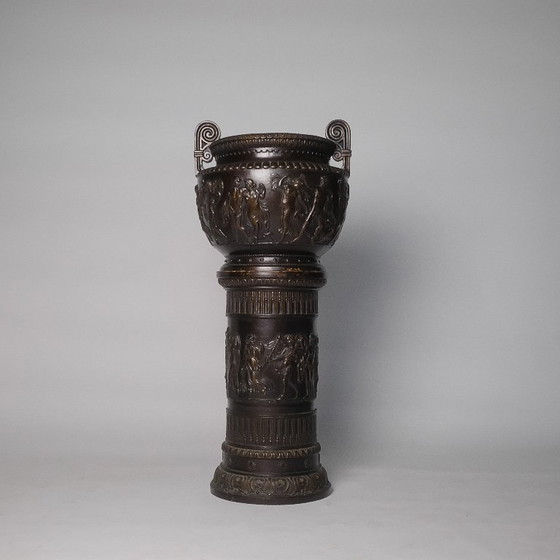
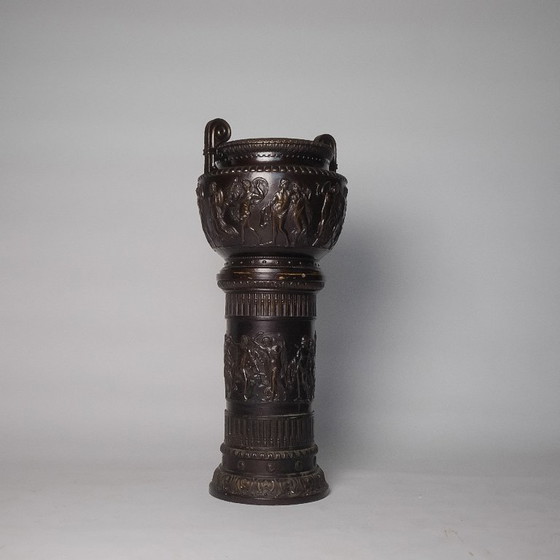
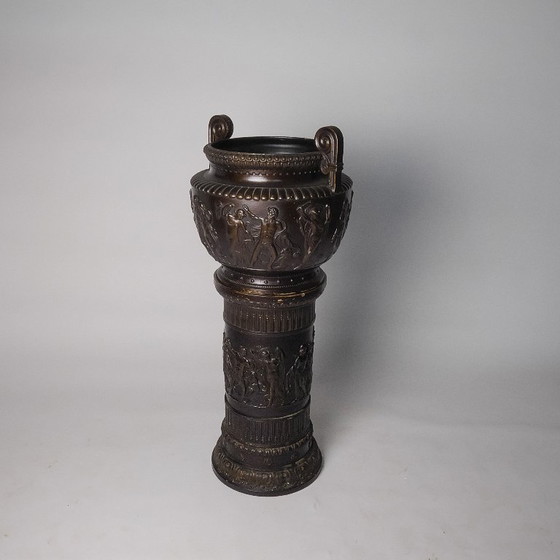
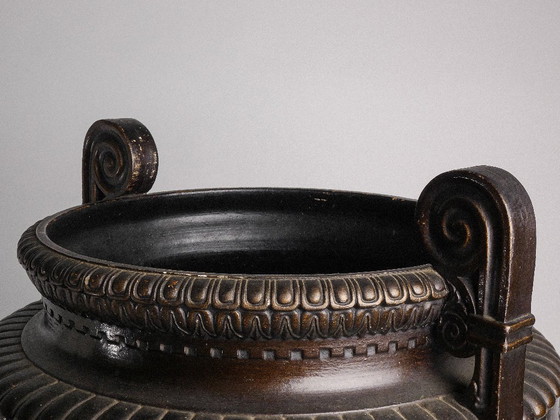
19th Century – Monumental Bacchic Urn on Pedestal – Italy
€1,870
Buy with confidence
Shop & pay safely with Buyer ProtectionDesigner items curated by WhoppahWe only pay the seller once you have safely received the itemTrusted payment methods


About this seller
ProfessionalProduct description
A piece that draws the eye—and never lets it go
There’s a distinct breath of fin-de-siècle Italy in this monumental urn on pedestal, standing 105 cm tall—a vessel of grace and a rare echo of a bygone art of living. It cannot be understood at a glance. You must walk around it, trace the lines of its Bacchic procession, let your gaze linger on the curve of the spiral handles, and allow the light to reveal the sculpted reliefs, little by little, as they come to life.
Crafted from dense terracotta and finished in a warm bronze patina, this piece plays elegantly with illusion. At first glance, it suggests metal—perhaps cast bronze—with its cold sheen and sculptural weight. But under the touch, and through the passage of time, a softer, more mineral substance reveals itself: expertly worked terracotta, shaped in the decorative tradition of late 19th-century Italian production. It was designed not merely to adorn, but to belong—intended for winter gardens, glazed galleries, or the orangeries of grand estates.
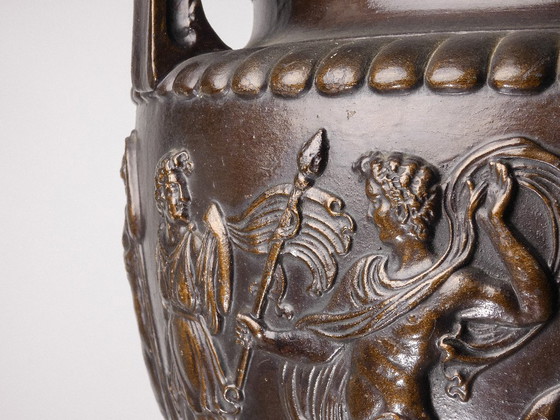
Along the body of the urn, the celebration of Bacchus comes to life—nude figures, athletic torsos, fluttering drapery. Each character seems caught mid-motion, frozen in a moment of ecstatic stillness: an arm raised, a veil escaping. The viewer, privileged, becomes a silent witness to this earthly theatre cast in clay. Beaded godrons, egg-and-dart motifs, and a row of dentils frame the piece with neoclassical harmony—echoes of antique vases from the Louvre or the Vatican. It’s a timeless balance that resonates in any setting, from a Haussmannian salon to a minimalist loft. The frieze, repeated twice, holds a depth of modeling that only the finest artisans could achieve: let light graze the surface, and warm golden highlights reveal the curve of a shoulder, the sweep of hair. The eye never tires—it returns. Again and again.
On the reverse, an incised mark offers a clue: “BACHANT. KL. V1000. W28. E.” “Bachant” reveals the theme; the letters and numbers correspond to a model now lost to most records—rare fragments pointing to a prestigious Italian manufactory. Few examples have survived. One matching piece, bearing the exact same mark, resurfaced across the Atlantic with a noted antiques dealer. And should your guests happen to be collectors, you might share this quiet detail: its twin, listed by a prominent New York gallery, was recently valued at close to €3,000.
The urn lifts freely from its pedestal, allowing for versatile display: as a floral vessel, a base for sculpture, or a sculptural object in its own right.
Perfection can feel cold—this piece carries the warmth of time. Soft golden highlights appear where hands have brushed the surface; here and there, chalky abrasions reveal the terracotta beneath. Far from detracting, these gentle signs of age enrich the narrative, lending the work the kind of authenticity we now seek—that trace of life no reproduction could ever replicate.
You’ve taken the time to see it—its lines, its traces, its presence. What you now contemplate is no longer just a decorative piece, but a tangible fragment of something once thought to belong only in museums or dreams. The only question that remains is whether you’ll let it continue its journey elsewhere—or choose to stop it, here, with you. For some works require no explanation: they simply belong. And if you’ve read this far, perhaps it’s because—somehow—it has already chosen you.
--
Dimensions (cm): 105 (H) x 42 (ø)
Weight: 21.6 kg
Origin & Period: Italy, late 19th century (technical dossier available upon request supporting this attribution)
Condition: Good overall condition, consistent with age and use
Condition: Good overall condition, consistent with age and use
Condition: Good overall condition, consistent with age and use
Specifications
ConditionGoodColorsBrownMaterialOtherNumber of items1Height105 cmWidth42 cmDepth42 cmSigns of usageChipped, Crack, Discoloring, Stains
Discover more
Seller information
About this seller
ProfessionalSaint-Martin-Lestra, FranceOn Whoppah since November 2024 • 3 sales