Mid-Century Modern: why these chairs keep going up in value, and how to start collecting
Mid-Century Modern is the most consistently appreciating slice of secondhand design, and that worries some buyers. I want to take the mystery out of it, share what drives the prices, and point you at the pieces that still feel like real value on Whoppah.

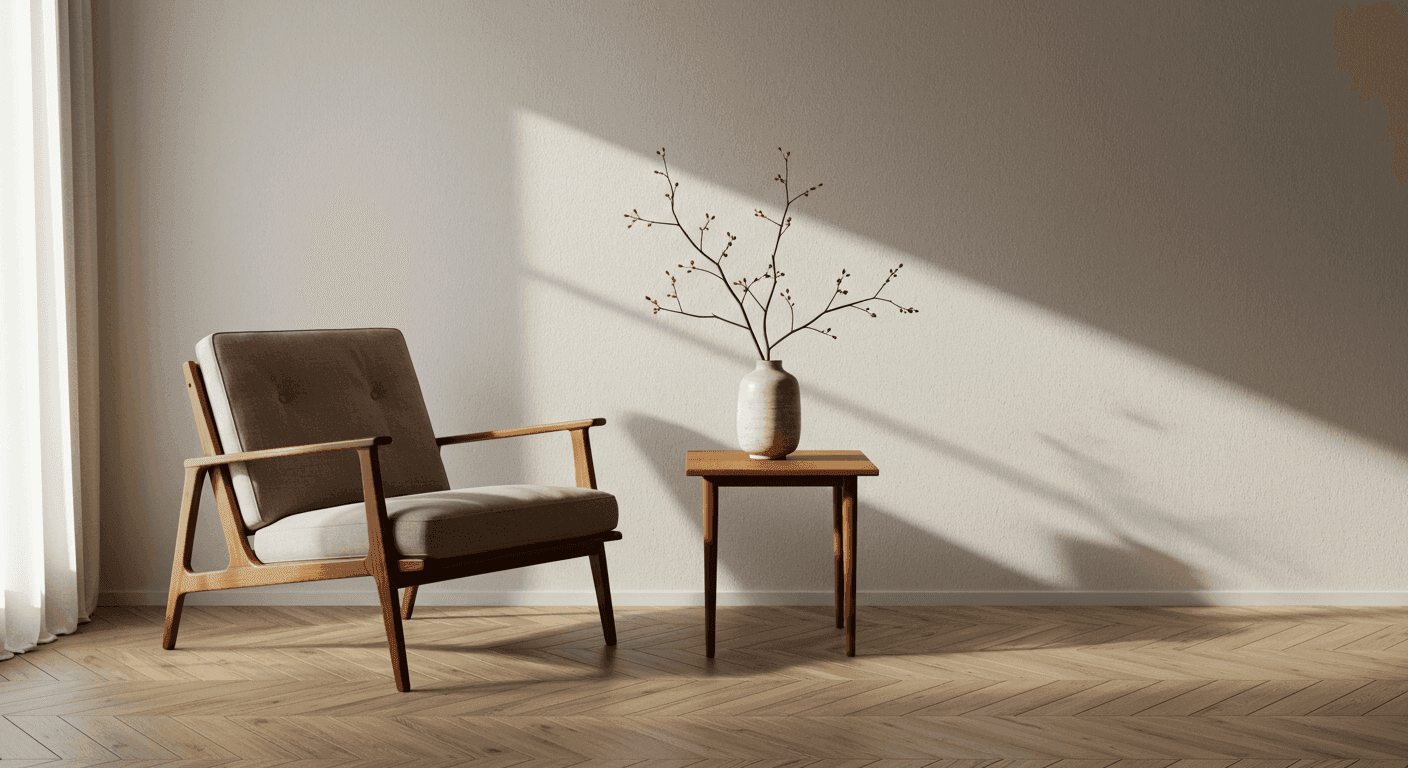
When we started Whoppah in 2019, our first hypothesis was that a quarter of Dutch homes had a piece of mid-century design worth resaling but no good place to do it. Six years and roughly 250,000 sold items later, that hypothesis turned out to be conservative. Mid-century is still the largest category on the platform every month.
What we actually mean by Mid-Century Modern
If you've ever scrolled through our listings and wondered whether "Mid-Century Modern" is a real style or marketing-speak, I get it. The label gets used a lot. So let me put a frame around it before anything else.
Mid-Century Modern, the way the term has settled, covers furniture and lighting made roughly between 1945 and 1970. The pieces share a handful of traits: tapered legs, organic curves, honest materials, and an obsession with mass production that, surprisingly, delivered serious quality. The Americans ran one strand of it (Eames, Saarinen and Bertoia at Knoll and Herman Miller), the Danish ran another (Wegner, Jacobsen, Juhl, Mogensen), and the Italians had a third going on at the same time (Gio Ponti, Joe Colombo, Vico Magistretti).
It helps to know what it isn't, too. Mid-Century Modern is not "anything in walnut from the 1960s". Plenty of the best pieces are in beech, oak or teak, and a lot of the interesting ones are unsigned regional production from small workshops in Denmark or Italy. The interiors magazines have been generous with the label, so it pays to read carefully. That's exactly the kind of gap I want to close here.
Why prices keep going up
I get asked this a lot, usually in a slightly worried way ("am I too late?"). Honestly, no, you're not, and here's why the trend is what it is.
A few forces are pushing in the same direction at once. First, most of the designers I just listed have passed away, and the factories that made the original pieces (Cassina, Knoll, Vitra, Carl Hansen and so on) have re-issued them at three to five times what a 1960s example costs on Whoppah. That re-issue price acts like an anchor. It quietly pulls the secondhand value of original-production pieces up with it.
Second, the supply is finite. Wegner died in 2007. Eames in 1978. Every year a few more original Wegner Wishbones land in a skip because someone didn't recognise what they had. The surviving population shrinks. Scarcity does what scarcity does.
Third, the people who grew up Instagram-saturated with these designs are now of an age (and income) where they can actually buy them. The 35 to 50 year olds who first saved a Pierre Paulin chair to a Pinterest board in 2017 are the ones bidding on Whoppah today. None of this is sudden, and none of it is going to reverse quickly.
Which pieces hold value best
The two things that matter most are provenance and originality. Let me show you what that means in practice.
A Hans Wegner CH24 Wishbone in original Carl Hansen production from the 1960s, frame original and paper-cord seat redone once, sits in the €600 to €1,200 band on Whoppah today. The same model in current Carl Hansen production retails for around €930 new. So the secondhand premium for a 60 year old original is roughly zero. The new retail acts as the floor, and a pre-loved vintage example is genuinely the smarter buy. I want you to feel confident about that, because the math is on your side.
Eames Lounge Chair and Ottoman in rosewood from the 1960s, with the original shell and leather replaced once or twice, sells between €3,000 and €6,000 on Whoppah. A new Vitra example with the standard veneer is €8,500. Again, the secondhand option is structurally cheaper for an object that is, by any reasonable measure, more interesting.
The category that doesn't hold value well is what I call "MCM-style": pieces designed in the 2000s to look mid-century. They depreciate like normal new furniture. Easy to confuse with the real thing in photos, so it pays to ask.
Where to start a collection
If this is your first piece, I'd suggest a single decision before anything else: pick one designer and live with one of their pieces for a year before adding a second. There's no rush. Wegner is the safest entry. He made about 500 chair designs and almost all of them are quietly, durably perfect. Once you can spot a Wegner across a room from the joinery alone, you're calibrated for the rest of mid-century.
The pieces consistently in the €300 to €800 band on Whoppah that I'd point you at:
- Hans Wegner CH36 dining chair, which runs in pairs and lets you assemble a set of four over a year as listings come up
- Børge Mogensen J39, which is the Shaker chair seen through Danish modernism, and a remarkable value
- Verner Panton S Chair in modern Vitra production, still cheaper used than new
- Arne Vodder sideboards, undervalued because the name is less famous than Wegner
What it really means in 2026
The investment angle is real, but it shouldn't be why you buy. The reason to buy is that these pieces sit comfortably in a room for fifty years and never look dated. I have a 1958 Wegner GE 290 in my own living room, and three sofas have come and gone around it. The chair just keeps being the chair.
If you want a market-side strategy, it's simple: save a search on Whoppah for the model or designer you've fallen for, let the alerts do the work, and react fast when something good lists. And don't haggle when the listed price already reflects originality and condition. The seller knows what they have, and trying to chip 15% off a fairly-priced piece tends to lose the listing to someone else.
I'm happy to be wrong here. If you message us and ask "is this a fair price for this piece", our curation team will tell you honestly. That's part of what we're for.