Gerrit Rietveld: the Dutch carpenter who built De Stijl in three dimensions
Rietveld was a small-town Dutch furniture maker who designed the Red and Blue chair in 1917 and never stopped working until 1964. He's the bridge between De Stijl painting and 20th-century furniture.

Rietveld pieces come through our curation room mostly via Dutch sellers, often from estates. Our team works closely with the Rietveld archive on attribution questions for unsigned pieces, which keeps the bar high.
A carpenter, not an architect (at first)
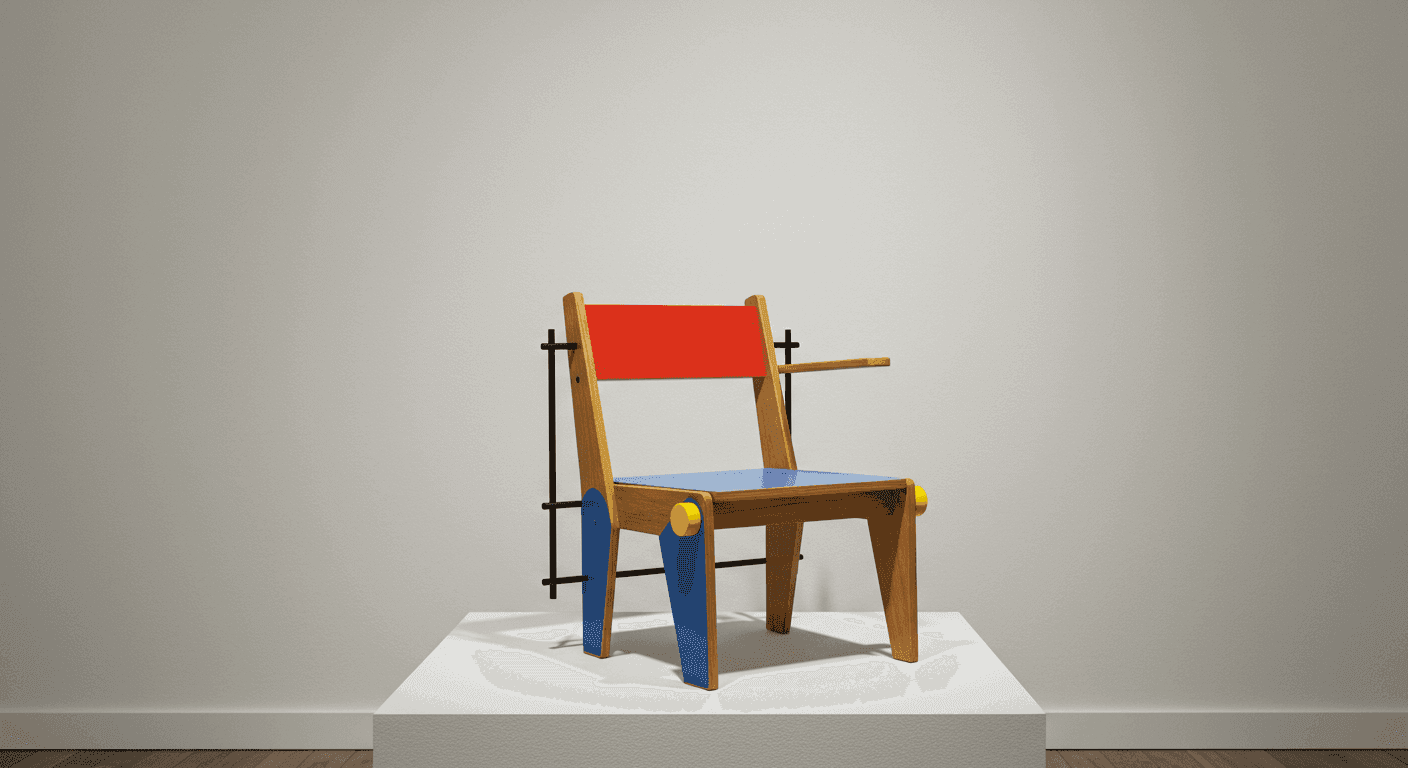
Gerrit Rietveld (1888 to 1964) trained as a furniture maker in his father's workshop in Utrecht and never lost the carpenter's instinct. When De Stijl emerged in 1917 (Mondrian, Theo van Doesburg, Bart van der Leck), Rietveld translated their flat colour-block paintings into three-dimensional furniture. The Red and Blue chair (1917, painted in 1923) is what came out: a chair built from straight wooden slats in primary colours and black, with no concession to comfort or ornament.
He went on to design buildings (the Rietveld Schröder House in Utrecht, 1924, is a UNESCO World Heritage site) and a long catalogue of furniture pieces that bridged De Stijl, Bauhaus and post-war Dutch modernism. For me, Rietveld is the most Dutch of the Dutch designers, in a way that's hard to explain unless you've stood inside one of his interiors.
The pieces
The Red and Blue chair (1917, painted 1923) is the icon. Originally hand-made in Rietveld's own workshop, then by Cassina under licence from 1971. Original Rietveld-workshop pieces from the 1920s are museum-grade and trade in five figures when they appear. Cassina reissues are around €4,500 retail; vintage Cassinas from the 1970s and 80s sit at €1,800 to €3,500.
The Zig-Zag chair (1934), the Z-shaped chair built from four flat panels, is the cleaner and arguably more elegant later design. Cassina production. Vintage examples €1,500 to €3,000 used.
The Crate furniture series (1934), designed for affordability, made from rough pine boards. The Crate chair, table and various storage pieces. Sometimes branded "Rood-Blauwe Stoel" or sold under their original Dutch names. Authentic vintage production is rare; reproductions and student-built examples are everywhere. Period originals run €1,200 to €3,500.
The Steltman chair (1963), one of his last designs, is a quieter, more architectural piece. Around €1,800 to €4,000.
Why he's good value on Whoppah
Rietveld's market in 2026 is, in my opinion, a little underpriced relative to his cultural importance. If you live in the Netherlands and care about Dutch design heritage, a Rietveld piece is one of the most meaningful things you can have in your home. Outside the Netherlands, his profile is lower than it should be, which keeps the secondary market accessible.
The Cassina I Maestri program produces authorised reissues with quality control, and they're a legitimate way to own the work without museum-grade pricing.
How to authenticate
Cassina pieces carry the Cassina label with serial. Original Rietveld-workshop pieces from the 1920s and 30s are typically unmarked, and authentication is provenance-based (auction records, museum loan history). For Crate-series pieces, look for the hand-cut joinery characteristic of period work; modern reproductions use machine joints.
If you're considering a high-value Rietveld, the Centraal Museum in Utrecht maintains a research archive and can sometimes help with authentication queries.