Eero Saarinen: the architect who designed the airport you've probably flown through
Eero Saarinen designed the TWA Flight Center, the St Louis Gateway Arch, and a small handful of chairs that became the visual shorthand for mid-century optimism. Here's the short field guide.

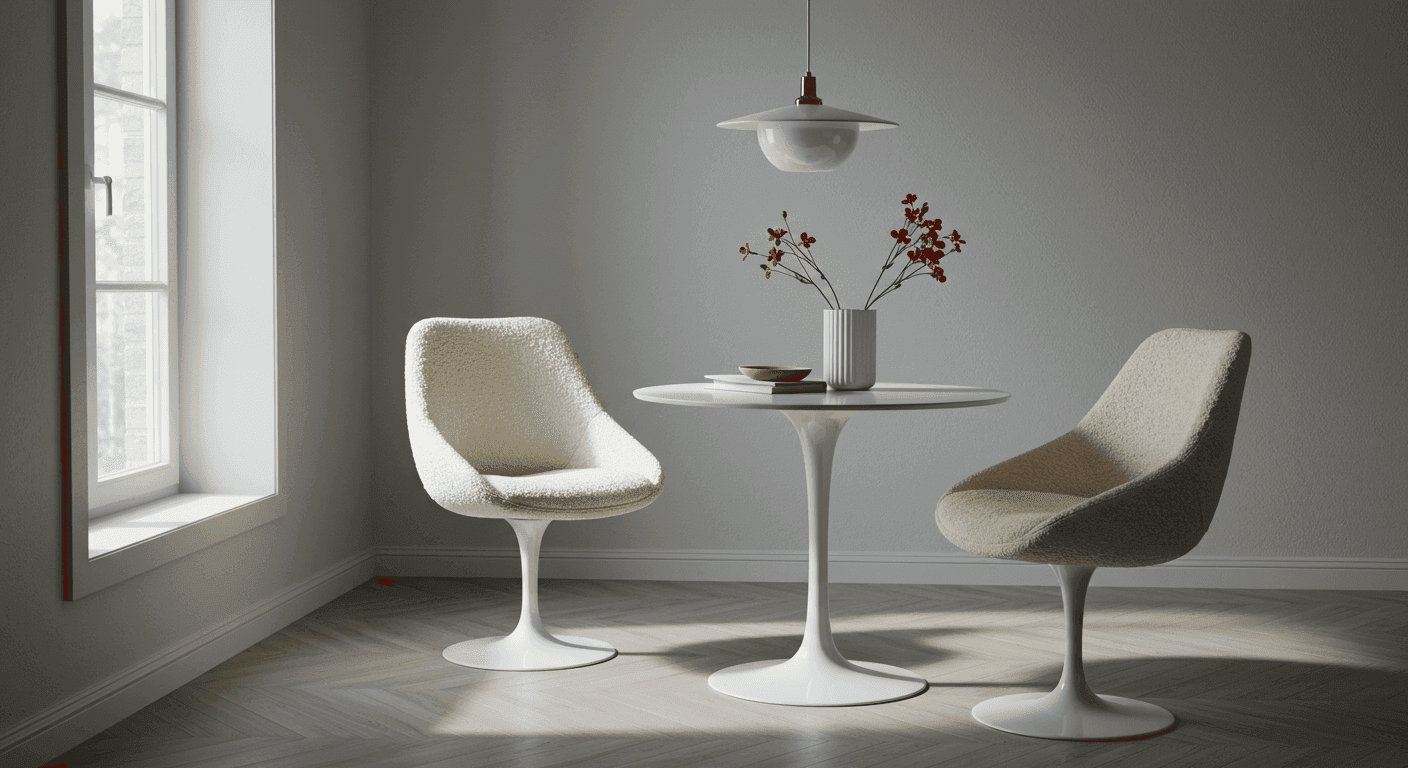
Eero Saarinen's Tulip and Womb chairs are evergreen on Whoppah. Our curators verify the Knoll markings and check the pedestal base condition, which is where most older pieces show wear.
An architect who also made furniture
Eero Saarinen (1910 to 1961) is mainly an architect: the TWA Flight Center at JFK (1962), the St Louis Gateway Arch (1965), the Dulles International Airport main terminal (1962). He worked with Charles Eames at Cranbrook in Michigan in the 1940s (they actually collaborated on the prize-winning Organic Chair entry to MoMA's Organic Design competition in 1940). After his architectural practice took off, he kept designing furniture for Knoll in parallel, and the small catalogue of Saarinen-for-Knoll pieces became canonical mid-century work.
He died young at 51 from a brain tumour. The architectural legacy is enormous; the furniture legacy is concentrated in maybe seven pieces, but those seven are extraordinary.
The pieces
The Tulip chair (1957, Knoll), the single-pedestal chair with the moulded plastic seat on a cast aluminum base, is the famous one. Saarinen was trying to "clear up the slum of legs" under tables (his words). The chair has been in continuous Knoll production since 1957. Vintage Knoll Tulips from the 1960s and 70s sell for €600 to €1,400 each on Whoppah; current Knoll retail is around €2,400.
The Tulip table (1957, Knoll), the matching round or oval pedestal table, runs €1,400 to €3,800 in vintage Knoll production depending on size and top material (marble is the premium).
The Womb chair (1948, Knoll), the deep curving lounge chair designed for Florence Knoll after she asked Saarinen for "a chair I can sit in like a basket", sits at €2,200 to €5,000 in good vintage Knoll production. Reupholstery is accepted and common.
The Womb settee (1948), the smaller two-seat companion, is €2,800 to €6,000.
The Executive chair series (1950, Knoll), the wooden-shell office chairs, are the more affordable Saarinens. €350 to €900 each.
What makes them feel like Saarinen
The single-pedestal idea (Tulip table and chair) is the Saarinen signature. He hated the visual noise of four legs and wanted clean continuous form. The Tulip chair achieves it because Saarinen worked out how to inject moulded fiberglass and how to integrate the plastic shell with a cast metal base. The seamless joint where the seat meets the pedestal looks effortless and is actually the result of significant engineering.
The Womb chair's signature is the deep curving cocoon shape. Saarinen literally designed it as a chair you can sit in cross-legged or curled up, which was unusual for 1948 American chair design. It set a template that Jacobsen's Egg (1958) and Castiglioni's Sanluca (1959) clearly built on.
Authentication
All authentic Saarinen-for-Knoll production carries Knoll branding. On the Tulip chair and table, look for the Knoll label on the underside of the base (newer) or stamped into the cast aluminum (older). The Womb chair has a metal Knoll plate on the frame, usually accessible if you tip the chair forward.
The Tulip chair is heavily copied. The giveaways are the seat material (real Knoll Tulips use moulded fiberglass with a painted finish; copies use injection-moulded plastic that looks shinier), and the base (real bases are cast aluminum and feel substantial; copies use cheaper alloys).