Bauhaus: the school that ran for fourteen years and shaped the next hundred
Bauhaus opened in 1919, closed under pressure in 1933, and still defines what 'modern' feels like in 2026. A friendly field guide to the pieces, the makers, and how to read the secondhand market without getting burned.

Bauhaus pieces move through Whoppah at roughly half the volume of Scandinavian and Italian mid-century, but the buyer demand per listing is higher; our curators have noticed Bauhaus listings sell faster than the platform average.
Fourteen years, one century of influence
Bauhaus is one of those words that gets thrown around a lot, often without much affection. So let me start with the simple version. The Bauhaus opened in Weimar in 1919, moved to Dessau in 1925, and closed in Berlin in 1933 under Nazi political pressure. Fourteen years, total. Yet almost every assumption you carry about what "modern" furniture should look like (tubular steel, primary colours, geometric clarity, no ornament unless it's structural) traces back to that one school.
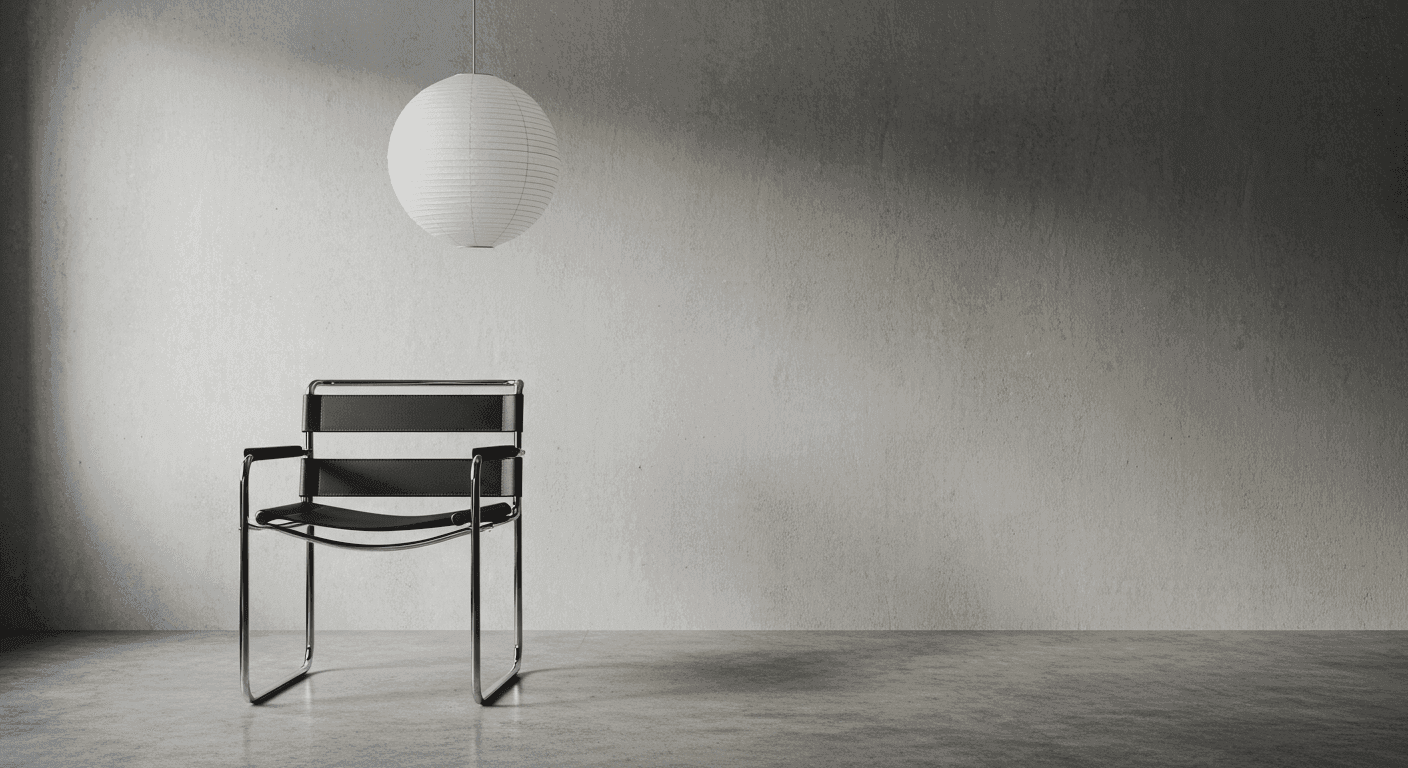
What made it different was the curriculum. Walter Gropius insisted that students learn craft and design, not one or the other. By the time Marcel Breuer designed the Wassily chair in 1925, he had actually bent the steel himself in the workshop. That kind of grounding is why Bauhaus pieces still feel solid a century later. The designers knew exactly what their materials could do.
The pieces still being made
A short list of Bauhaus-era objects you can still buy new today, with the manufacturer that holds the licence:
- Wassily chair (Marcel Breuer, 1925), Knoll
- Cesca chair (Marcel Breuer, 1928), Knoll
- Barcelona chair (Mies van der Rohe with Lilly Reich, 1929), Knoll
- MR10 cantilever chair (Mies, 1927), Knoll and Thonet
- Bauhaus chess set (Josef Hartwig, 1923), Naef
- Wagenfeld table lamp (Wilhelm Wagenfeld, 1924), Tecnolumen
Original-period production from the 1920s and early 30s is genuinely rare. Those pieces trade in five figures at auction. The Bauhaus furniture you'll see on Whoppah is mostly authorised re-issues from the 1960s onward, which is its own real market with its own pricing logic. Both are legitimate, just very different price points.
How to spot a real Wassily
Marcel Breuer's B3 chair (renamed Wassily after Kandinsky, who got one for his apartment at the school) has been in Knoll production since 1968. Original 1920s Wassilys are almost entirely in museums now. So when you see a "vintage Wassily" on the secondhand market, you're almost certainly looking at a Knoll piece from the 70s, 80s or 90s. That's good news for buyers, because Knoll's Wassilys are excellent.
What to check on a Knoll-era piece: a leather hide label sewn into the seat panel that says KNOLL INTERNATIONAL, a small metal serial-number plate on the underside of the frame, and clean tubular steel with no welded sleeve joints visible. The chair frame is a single continuous bent tube. If you see visible joint sleeves, it isn't Knoll. Saddle leather (cognac, black or white) is the original Knoll specification.
A genuine 1970s Knoll Wassily in good condition sits at €700 to €1,400 on Whoppah. A 1990s Italian unauthorised copy goes for €150 to €300, and is worth that. Comfortable, fine for what it is, but not the same object. There's no shame in starting with the copy if it suits your budget. Just know what you've got.
Mies and Reich at the Barcelona Pavilion
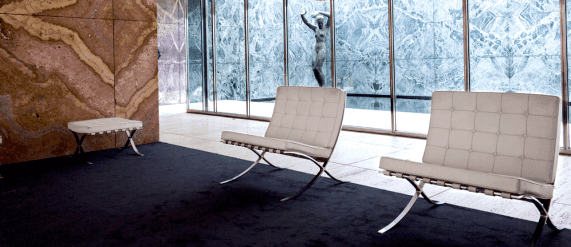
The Barcelona chair was designed for the German Pavilion at the 1929 World's Fair in Barcelona. Mies and Lilly Reich made it together, for the King and Queen of Spain to sit on during the opening ceremony. Reich's contribution is too often left out of that story, and it's worth correcting whenever you can.
The chair has been in continuous Knoll production since 1953. An original from the first decade in pristine condition (cognac leather, polished stainless frame) sells in the €4,000 to €8,000 range on Whoppah. Newer Knoll editions from the 1990s sit around €2,000 to €3,500. Anything below €1,000 is almost certainly an Italian or Chinese unauthorised copy. You'll spot the difference in the chrome quality, the leather weight, and the screw fixings visible from underneath.
Why Bauhaus still sells
Two reasons, mostly. First, the discipline of the period produced objects with no decoration that could date. A 2026 living room with a Cesca chair and a Wagenfeld lamp doesn't read as period or nostalgic. It reads as confident. Second, all of these pieces have been so heavily mythologised that they're gift-able and self-explanatory in a way that, say, post-war Italian design isn't. A friend walks in, sees the chair, knows the chair.
If this is your first real Bauhaus piece, I'd start with the Cesca chair. It's the lightest, the most useful day to day, the cheapest to acquire in genuine Knoll production, and it'll quietly stay in your home for thirty years.
What to skip
Unauthorised steel-and-leather "Bauhaus-style" chairs from generic Italian factories are everywhere on open marketplaces. They have their place, but they're not the same object and they're not a long-term keep. Whoppah's curation team rejects most of them. It's still useful to know the difference yourself, so you don't end up paying authentic-Knoll money for something that isn't.
If you're unsure about a specific listing, send us a message. We'd much rather answer "is this real" than have you discover later that it isn't.